The archaeological evidence for Christmas tells a remarkable story. For nearly two centuries, skeptical scholars dismissed the Christmas narrative as a pious legend disconnected from historical reality. The virgin birth was claimed to be borrowed mythology. Bethlehem appeared too small and obscure. The census under Quirinius created supposed chronological problems. The manger in a cave sounded like symbolic invention. Gospel accounts of Herod, the shepherds, and ritual practices were treated as theological fabrication rather than historical reporting.
Then archaeologists started digging, and one by one, the supposedly fictional details found vindication in stone, pottery, and papyrus:
- Caves beneath Bethlehem homes
- Evidence of Herod’s paranoia carved into hillsides
- Egyptian documents confirming Roman census practices
- Ritual vessels matching Gospel descriptions
A pattern emerged: where the Gospel writers could be tested against external evidence, they proved remarkably accurate. Defying every human convention, God decided to reveal his Son at Christmas through the humblest of all ways, and the stones are witnesses.
Archaeology cannot prove everything. No spade will unearth the virgin birth or angelic announcements. But archaeology can test whether Gospel writers knew first-century Judean geography, culture, politics, and practices. And here the verdict is clear: they got their details right. This matters because accurate incidental details argue for early composition and eyewitness sources, not late legendary development.
Let the stones speak.
The Church of the Nativity: Preserving the Cave Tradition
Today, you can stand inside Bethlehem’s Church of the Nativity and descend the stone steps into the Grotto. Here, beneath elaborate Orthodox decorations, silver lamps, and centuries of Christian veneration, lies a cave that local tradition has identified as Jesus’s birthplace since the second century.
In 326 AD, Emperor Constantine’s mother, Helena, commissioned a church built directly over this cave. The church she built—parts of which still stand today—wasn’t constructed on a convenient location or a symbolically significant spot. It was built over a specific cave that early Christians identified as the birthplace. Jerome, who lived in Bethlehem from 386-420 AD and translated the Bible into Latin, repeatedly confirmed in his writings that this cave was venerated as the birthplace from time immemorial.
Archaeological excavations beneath the current church floor have confirmed the presence of the original cave structure. But more significantly, archaeology has vindicated what skeptics long dismissed: the claim that Jesus was born in a cave used as a stable.
First-century Palestinian homes, especially in the Bethlehem hill country, commonly used natural or carved caves as ground-floor areas for sheltering livestock, with the family’s living quarters built above. Stone mangers—feeding troughs carved from limestone—have been discovered in such cave-stables throughout the region. This wasn’t theological symbolism. This was ordinary Palestinian architecture.
Luke’s Gospel states:
“She wrapped him in swaddling cloths and laid him in a manger, because there was no place for them in the inn.”
Luke 2:7
No elaboration. No attempt to explain or justify. Just a straightforward statement that makes perfect sense to anyone familiar with first-century Judean housing practices—and makes no sense as invented symbolism.
The cave tradition’s early attestation and archaeological confirmation suggest the location was remembered and preserved precisely because people knew where it actually happened.
Bethlehem: A Small Town Matching Gospel Descriptions
Bethlehem never figured prominently in ancient records. No major battles occurred there. No significant political events. It was precisely what the Gospels portray: a small agricultural village about six miles south of Jerusalem, known primarily for its connection to King David a thousand years earlier.
Archaeological surveys and excavations reveal a modest settlement from the first century. Population estimates range from 300 to 1,000 residents – large enough to be called a town, small enough that a Roman census could plausibly require residents to gather there. The modest size matches Luke’s portrayal perfectly: significant enough to be David’s city, small enough that “there was no place for them in the inn” makes sense.
The economic profile matches Gospel details. Evidence of agricultural and pastoral life confirms this was farming and shepherding country:
- Grinding stones
- Storage pits
- Animal bones
This validates Luke’s mention of:
“Shepherds living out in the fields nearby, keeping watch over their flocks at night.”
Luke 2:8
These weren’t invented characters placed in a symbolic landscape. They were the actual economic demographic of the Bethlehem region.
The town’s proximity to Jerusalem is crucial. Six miles is easily walkable—a two-hour journey for Mary and Joseph coming from Nazareth to register for the census:
“Joseph also went up from Galilee, from the town of Nazareth, to Judea, to the city of David, which is called Bethlehem, because he was of the house and lineage of David.”
Luke 2:4
Close enough to explain why they traveled there, far enough to explain why they ended up in a stable when the small town’s limited lodging was full.
Significantly, archaeological evidence shows Bethlehem was continuously inhabited during the first century BC and first century AD, with no destruction or abandonment that would disrupt local memory. This continuity allowed the specific birthplace tradition to be preserved and passed down.
Herod and Herodium: Archaeological Evidence of the Paranoid King
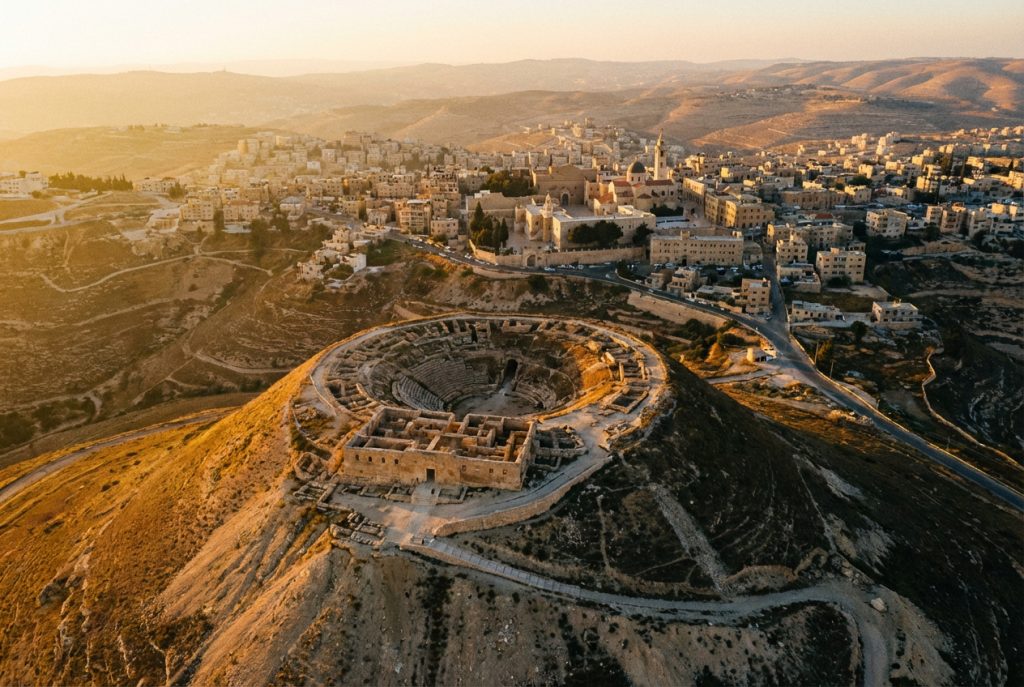
Three miles southeast of Bethlehem, an artificial mountain rises. Herodium—Herod the Great’s fortress-palace—dominates the landscape, visible from Bethlehem itself. The massive complex, built between 23 and 15 BC, stands as archaeological testimony to Herod’s ambition, resources, and paranoia.
Excavations at Herodium reveal the fortress’s sophisticated design:
- Circular structure with seven stories
- Elaborate palace apartments
- Pools and gardens
- Underground cisterns
- Lower city with palace, service buildings, and chariot-racing course
In 2007, archaeologist Ehud Netzer discovered Herod’s tomb at the site, confirming ancient accounts.
But Herodium tells us more than just where Herod was buried. The fortress’s design reveals the mind of its builder:
- Multiple escape routes
- Defensive positions
- Elaborate security measures
This was a palace built by someone who was a bit paranoid, trusted no one, and feared losing power.
Josephus’s Antiquities of the Jews confirms what the archaeology suggests. Herod’s documented executions include:
- His favorite wife, Mariamne
- Her mother Alexandra
- His two sons, Alexander and Aristobulus
- His oldest son, Antipater (five days before Herod’s own death)
When Augustus Caesar learned of these killings, he reportedly quipped it was safer to be Herod’s pig than Herod’s son (pigs, at least, were safe in a Jewish household that kept kosher).
Matthew’s Gospel portrays Herod responding to news of a rival king’s birth with murderous fury:
“Then Herod, when he saw that he had been tricked by the wise men, became furious, and he sent and killed all the male children in Bethlehem and in all that region who were two years old or under.”
Matthew 2:16
Skeptics long doubted that this massacre occurred, citing the lack of mention in Josephus. But Josephus’s silence proves nothing—Bethlehem was tiny, the death toll would have been 20-30 infants at most, a minor atrocity in a reign marked by far larger massacres. Given Herod’s documented brutality—killing his own sons, slaughtering potential rivals in a small village fits his established pattern perfectly.
The archaeology of Herodium, combined with Josephus’s historical testimony, confirms the Gospel’s portrayal: Herod was precisely the kind of paranoid ruler who would kill infants to eliminate a perceived threat to his throne.
Roman Census Practices: Evidence from Egyptian Papyri
For decades, skeptics attacked Luke’s census account as historically impossible. Critics argued:
- Romans wouldn’t require people to return to ancestral homes for registration
- Luke confused the census with Quirinius’s later census in 6 AD
- The whole account was invented to get Jesus to Bethlehem to fulfill Micah’s prophecy
Then archaeologists found the papyri.
Egyptian papyrus documents from the Roman period prove that the requirement to return to ancestral property for census enrollment was a standard Roman practice in that region. A 104 AD census declaration from Egypt explicitly states:
“I register myself and those of my household for the census of the past year…I have my origins in the city. I request that a copy of this declaration be posted in the public place.”
Another papyrus from 48 AD shows officials ordering:
“Because of the approaching census, it is necessary that all those residing for any cause away from their home districts shall be summoned to return to their own governments in order that they may complete the family registration of the enrollment.”
The pattern is clear: Roman census practice in eastern provinces included registration at one’s place of origin or property ownership. Luke’s account of Joseph traveling to his ancestral city isn’t historically implausible—it matches documented Roman administrative procedures.
Debates continue about the precise date and whether Quirinius governed Syria during Herod’s reign (some scholars propose he held the position twice, others suggest Luke conflated censuses). But the fundamental claim—that the Romans conducted censuses that required travel to ancestral locations—has been vindicated by documentary evidence.
Jewish Ritual Practices: Material Culture Matches Gospel Details
The Gospels contain dozens of incidental details about first-century Jewish life—details that serve no theological purpose but reflect intimate knowledge of the culture. Archaeology has confirmed these details repeatedly.
Luke mentions Mary’s purification offering:
“And when the time came for their purification according to the Law of Moses, they brought him up to Jerusalem to present him to the Lord…and to offer a sacrifice according to what is said in the Law of the Lord, ‘a pair of turtledoves, or two young pigeons.'”
Luke 2:22-24
This detail reveals economic status. Leviticus 12:8 specified that women who couldn’t afford a lamb could offer two birds instead. Archaeologists have excavated remains of the temple’s animal markets, confirming the sale of doves for sacrifices. The detail is economically precise, culturally accurate, and matches other Gospel indicators of Jesus’s family poverty—hardly the kind of detail someone would invent.
Stone vessels for ritual purification, mentioned throughout the Gospels, have been excavated extensively across Judea. These weren’t symbolic inventions—stone vessels were explicitly used because stone, unlike pottery, doesn’t contract ritual impurity according to Jewish law. Hundreds of such vessels have been found, confirming the Gospel writers’ knowledge of Jewish purity practices.
Burial customs match perfectly. Luke mentions Jesus being “wrapped…in swaddling cloths” at birth, and the Gospels record Jesus being wrapped in linen cloths at burial. Archaeological discoveries of first-century burial sites show this was standard practice—bodies wrapped in linen, placed in rock-cut tombs, with the cloth strips and burial spices exactly as the Gospels describe.
These aren’t major theological claims. They’re incidental details that only someone intimately familiar with first-century Judean life would know—or someone recording eyewitness testimony from people who lived it.
The Shepherd Fields: Geography and Tradition
East of Bethlehem, in the area known as Beit Sahour, lies a field that continuous Christian tradition has identified as where the angels appeared to shepherds. Byzantine churches dating to the 4th-6th centuries mark the site, with inscriptions referring to the angelic announcement.
Skeptics might dismiss this as a pious tradition invented centuries later. But the shepherd’s connection to Bethlehem isn’t arbitrary—it’s rooted in historical practice and geography.
The Mishnah, recording Jewish oral traditions, indicates that sheep raised in the Bethlehem area were designated for temple sacrifices. Migdal Eder, “the tower of the flock” mentioned in Micah 4:8, was traditionally located near Bethlehem and associated with the raising of sacrificial lambs.
This creates a theologically rich but historically grounded detail. Shepherds watching flocks near Bethlehem were likely watching lambs destined for Jerusalem’s temple—the very sacrifices that Jesus would fulfill and end. John the Baptist called him:
“Lamb of God who takes away the sin of the world”
John 1:29
Luke could have invented shepherds as witnesses. But why choose this specific occupation in this specific location with these specific theological resonances unless it actually happened this way? The historical practice of raising temple lambs near Bethlehem makes the Gospel account more, not less, credible.
Archaeological remains in the area confirm the presence of pastoral activity during the first century. The location’s proximity to Bethlehem—about a 15-20 minute walk—makes the shepherds’ quick arrival plausible:
“Let us go over to Bethlehem and see this thing that has happened, which the Lord has made known to us.”
Luke 2:15
The continuous veneration of the site from early centuries, while not proving the specific events, demonstrates that early Christians connected the angelic announcement to a particular geographic location—suggesting historical memory rather than invented symbolism.
The Pattern of Vindication
The archaeological evidence for Christmas follows a consistent pattern:
Gospel detail → Scholarly skepticism → Archaeological discovery → Gospel Vindication
Cave stable? Dismissed as symbolic → Cave-stables excavated throughout the region → Gospel Vindicated
Bethlehem too small? Claimed invented → Archaeological surveys confirm a modest first-century town → Gospel Vindicated
Census requiring travel? Declared impossible → Egyptian papyri document practice → Gospel Vindicated
Herod’s brutality? Considered exaggerated → Herodium excavated, Josephus confirmed → Gospel Vindicated
Jewish ritual details? Assumed theological invention → Material culture matches precisely → Gospel Vindicated
Shepherd fields near Bethlehem? Thought symbolic → Historical practice confirmed, location preserved → Gospel Vindicated
This pattern matters. It demonstrates that the Gospel writers possessed accurate, detailed knowledge of first-century Palestinian geography, culture, politics, and practices. Such knowledge argues against late legendary development written by authors distant in time and place from the events. It supports early composition by writers with access to eyewitness sources or who were eyewitnesses themselves.
Archaeology cannot prove the virgin birth. It cannot verify angelic appearances. It cannot demonstrate that the infant in Bethlehem was divine. These claims lie beyond archaeology’s reach and must be evaluated on other grounds.
But archaeology can test whether the Gospel writers knew what they were talking about when describing the physical, cultural, and historical setting. And here the verdict is remarkably consistent: they got their details right.
The incidental details—those serving no theological purpose—are precisely where fabricators make mistakes:
- They get geography wrong
- They misunderstand cultural practices
- They anachronistically project later customs backward
- They make the kinds of errors that reveal distance from events
The Gospel writers make none of these errors:
- Their Bethlehem is the right size
- Their Herod matches the historical record
- Their census practice aligns with documented Roman procedures
- Their Jewish rituals reflect authentic first-century practice
- Their architectural details fit the archaeological evidence
This level of accuracy doesn’t prove divine inspiration. But it does argue powerfully that the Gospel writers were reporting what they had received from reliable sources close to the events—not inventing pious legends generations later.
Conclusion: The Stones Cry Out
Jesus once told his critics:
“I tell you, if these were silent, the very stones would cry out.”
Luke 19:40
Two thousand years later, the stones are crying out—testifying through archaeology that the Gospel writers preserved authentic historical memory.
The cave beneath the Church of the Nativity. The modest size of first-century Bethlehem. The paranoid brutality was evidenced at Herodium. The census papyri from Egypt. The stone vessels and burial cloths from Judean excavations. The shepherd fields east of Bethlehem. Each discovery adds another voice to the chorus: the writers got their details right.
This doesn’t remove the need for faith. Christianity’s central claims—incarnation, virgin birth, resurrection transcend what archaeology can verify. But the Christmas story isn’t asking us to believe the unverifiable wrapped in the implausible. It’s asking us to believe the miraculous embedded in the historical.
And the stones keep crying out: the history is solid.
When Luke writes about Caesar Augustus’s decree, he’s writing history. When he mentions Quirinius’s governorship, he’s anchoring events in time. When he describes the journey to Bethlehem, he’s reporting geography. When he mentions the manger, the swaddling cloths, the shepherds, the temple offering, he’s preserving cultural details with remarkable precision.
The archaeological evidence doesn’t prove Jesus is the Messiah. But it demonstrates that the Gospel writers were careful historians recording real events in real places with real people, not mythmakers inventing legends.
For those seeking the meaning of the Christmas story, see The Unexpected Glory – Christmas Reveals the Heart of God. For those examining its historical basis, the stones have spoken. And their testimony is clear: this happened. In Bethlehem. In a cave. Under Herod’s reign. When shepherds still watched temple flocks in nearby fields.
The details are accurate. The history is solid. And that makes the central claim—that God became human in this specific time and place worthy of serious consideration.
The stones cry out because the Gospel writers got their details right. And details matter, because truth always wears the texture of reality.
“If these were silent, the very stones would cry out” (Luke 19:40).
Discover more from Cold and Lonely Truth
Subscribe to get the latest posts sent to your email.