Can the Bible be trusted, or did Christians corrupt it after Islam arose? This question lies at the heart of Christian-Muslim dialogue. Islamic scholars claim the Bible was falsified (taḥrīf) to hide prophecies about Muhammad and insert doctrines like the Trinity and Christ’s deity. But what if this entire theory was systematically destroyed and Islam was debunked—not in modern times, but only 120 years after Muhammad’s death?
In AD 775, an imprisoned Syrian patriarch named George of B’eltan wrote what may be the most devastating refutation of Islam ever penned. Locked in a Baghdad prison cell for nine years by the Abbasid Caliphate, George crafted four simple questions that expose the fatal logical impossibility of the Islamic claim. His questions have never been answered.
What makes George’s response historically explosive is not just its early date (making it one of the earliest Christian responses to Islam)IJakob, Joachim. Syrisches Christentum und früher Islam: Theologische Reaktionen in syrisch-sprachigen Texten vom 7. bis 9. Jahrhundert. Innsbruck-Wien: Tyrolia-Verlag, 2021., but three unprecedented features:
- He quotes the Quran itself to disprove Islamic claims—possibly the very first Christian writer to do so in Syriac
- He asks for specific manuscript evidence that Muslims cannot produce (and still haven’t after 1,250 years)
- He pioneered the “True Religion Apology” that would dominate Christian apologetics for centuries
Recently translated from Vatican manuscript Syriac 154, George’s chapter 49 demonstrates that the Islamic corruption theory failed immediately upon examination—even before the major Greek codices were widely known, before modern textual criticism, and before archaeology confirmed biblical reliability.IIJacobs, Bert. “An Early Syriac Response to the Charge of Taḥrīf in George of Bʿeltan’s Commentary on the Gospel of Matthew.” In Eastern Christians’ Engagement with Islam and the Qur’ān, edited by Markus Groß and Karl Pinggéra. Leiden: Brill, 2025.
This is the story of how four questions destroyed a religion’s foundational claim, why those questions remain unanswered after twelve centuries, and what this means for Christian-Muslim dialogue today. If you’ve ever wondered whether the Bible can be trusted against Islamic objections, the answer was settled in a Baghdad prison cell in AD 775.
The charge: Christians corrupted the Bible.
The evidence required: Manuscripts showing the corruption.
The evidence produced: None. Not one manuscript. Not in AD 775. Not today.
Let’s examine how George of B’eltan systematically demolished Islamic apologetics—and why modern Muslim scholars still struggle with his arguments.
The Islamic Charge: Taḥrīf (Biblical Falsification)
What is Taḥrīf?
The Arabic term taḥrīf (تحريف) literally means “distortion” or “falsification.” It refers to the Muslim belief that Jews and Christians have corrupted their scriptures—specifically the Torah (Tawrat), Psalms (Zabur), and Gospel (Injil).

The concept originates from four Quranic verses that accuse certain Jews of tampering with scripture:
- Quran 2:75 – “Do you covet that they would believe for you while a party of them used to hear the words of Allah and then distort it after they had understood it?” IIIThe Qur’an, translated by M.A.S. Abdel Haleem. Oxford: Oxford University Press, 2004.
- Quran 4:46 – “Among the Jews are those who distort words from their [proper] usages…”IVThe Qur’an, translated by M.A.S. Abdel Haleem. Oxford: Oxford University Press, 2004.
- Quran 5:13 – “They distort words from their [proper] usages…”VThe Qur’an, translated by M.A.S. Abdel Haleem. Oxford: Oxford University Press, 2004.
- Quran 5:41 – “They distort words beyond their [proper] usages…”VIThe Qur’an, translated by M.A.S. Abdel Haleem. Oxford: Oxford University Press, 2004.
The Quranic Paradox
Here’s where it gets complicated. While these verses accuse some Jews of tampering, the Quran simultaneously affirms the Torah and Gospel as genuine divine revelation:
- Quran 3:3 – “He has sent down upon you the Book in truth, confirming what was before it. And He revealed the Torah and the Gospel.”VIIThe Qur’an, translated by M.A.S. Abdel Haleem. Oxford: Oxford University Press, 2004.
- Quran 5:46 – “We sent Jesus, the son of Mary, confirming that which came before him in the Torah; and We gave him the Gospel, in which was guidance and light.”VIIIThe Qur’an, translated by M.A.S. Abdel Haleem. Oxford: Oxford University Press, 2004.
- Quran 5:47 – “So let the people of the Gospel judge by what Allah has revealed therein.”IXThe Qur’an, translated by M.A.S. Abdel Haleem. Oxford: Oxford University Press, 2004.
- Quran 10:94 – “So if you are in doubt about that which We have sent down to you, then ask those who have been reading the Scripture before you.”XThe Qur’an, translated by M.A.S. Abdel Haleem. Oxford: Oxford University Press, 2004.
This creates a fundamental tension: How can the Quran both affirm previous scriptures and claim they’ve been corrupted?
Here’s the dilemma: the Quran states that the Torah and the Gospels are to be trusted. However, the Torah and Gospels contradict the Quran. The implications are airtight and problematic for Islam. Either the Quran is false because it contradicts the Torah and Gospels inherently, or it is false because it lends credibility to the Torah and Gospels, which contradict it. In both cases, the Quran is false. For more details, read the article, Did You Know That Koran Validates the Bible and Invalidates Itself? To defend Islam against this obvious, destructive argument, Muslim scholars have claimed that the Torah and Gospels have been corrupted. On its surface, this is self-destructive for Islam because by claiming that the Torah and Gospels have been corrupted, Muslims are undermining Islam since the Quran itself claims the Torah and Gospels are to be trusted. But it gets worse. Far worse when you consider the early historical answer to Taḥrīf by George of B’eltan. But before we delve into the substance of his argument, let’s dive into how the doctrine of Taḥrīf evolved and why.
The Evolution of the Taḥrīf Doctrine
Phase 1: Early Islam (7th-9th Century) – Interpretive Corruption
The earliest Muslim scholars actually believed the text of the Bible remained intact. They argued that Jews and Christians had merely misinterpreted their scriptures. This view is called taḥrīf al-maʿnā (corruption of meaning/interpretation).
Key early Muslim scholars who held this view:
- Ibn al-Layth (late 8th century) – Believed only the interpretation had been distorted
- Ibn Rabban al-Tabari (d. 855) – Used the Torah as a historical source and to find prophecies about Muhammad
- Ibn Qutayba (d. 889) – “It is clear that what is meant by tahrif is giving a wrong interpretation to an otherwise genuine text” XIAdang, Camilla. Muslim Writers on Judaism and the Hebrew Bible: From Ibn Rabban to Ibn Hazm. Leiden: Brill, 1996, pp. 225-227.
- Al-Qasim ibn Ibrahim (9th century) – His “Refutation of the Christians” argued for interpretive corruption but not textual changes
As scholar Camilla Adang notes: “The MAJORITY of [early Muslim] authors subscribe to a mild interpretation of the Koranic allegation of large-scale tampering with the Torah… according to this interpretation, only the sense of the biblical text had been changed while the text itself remained intact.”XIIAdang, Camilla. Muslim Writers on Judaism and the Hebrew Bible: From Ibn Rabban to Ibn Hazm. Leiden: Brill, 1996, p. 251.
This makes historical sense: early Muslims needed the Bible to contain prophecies about Muhammad. If the text itself was corrupted, how could they point to biblical passages as proof of his coming?
Phase 2: The Shift to Textual Corruption (11th Century) – Ibn Ḥazm
Everything changed with Ibn Ḥazm (AD 994-1064), an Andalusian scholar who became “the first Muslim to posit the Doctrine of Biblical Corruption” in its full form.XIIIAdang, Camilla. Muslim Writers on Judaism and the Hebrew Bible: From Ibn Rabban to Ibn Hazm. Leiden: Brill, 1996, pp. 237-251. This view is called taḥrīf al-naṣṣ (corruption of the text itself).
Ibn Ḥazm’s revolutionary claims:
- The Bible is not just erroneous—it’s anti-Scripture: He called it “an accursed book” and “the product of satanic inspiration”
- Ezra corrupted the Torah: He rejected Mosaic authorship and blamed Ezra the scribe for fabricating the text
- Internal contradictions prove falsification: He catalogued chronological errors, geographical inaccuracies, and theological impossibilities
- Logical necessity: Since the Quran is true and contradicts the Bible, the Bible must be false
According to one scholar, Ibn Ḥazm’s conclusion “marked A DEPARTURE FROM THE PREVAILING OPINION BEFORE HIS TIME and was followed by subsequent writers only with careful qualifications.” XIVMichel, Thomas F. A Muslim Theologian’s Response to Christianity: Ibn Taymiyya’s Al-Jawab al-Sahih. Delmar, NY: Caravan Books, 1999, pp. 89-90.
Even the famous Muslim historian Ibn Khaldun (d. 1406) pushed back against Ibn Ḥazm, writing that “thorough scholars cannot accept the statement that Jesus altered the Torah, since custom prevents people who have a (revealed) religion from dealing with their divine scriptures in such a manner.” XVIbn Khaldun. The Muqaddimah: An Introduction to History, translated by Franz Rosenthal. Princeton: Princeton University Press, 1967.
Phase 3: Modern Apologetics (20th-21st Century)
Today, the doctrine of biblical corruption has become mainstream in popular Muslim apologetics, though scholars remain divided. The charge typically focuses on:
- The doctrine of the Trinity (allegedly added by Christians)
- The deity of Christ (supposedly not in the original Gospel)
- The crucifixion (claimed to be a later insertion)
- Prophecies about Muhammad (allegedly removed)
However, no Muslim scholar has ever produced:
- An “uncorrupted” manuscript to compare
- Historical evidence of when the corruption occurred
- Explanation of how a global conspiracy could have succeeded
- Any contemporary records of the alleged falsification
Enter George of B’eltan: The Four Questions
Who Was George?
George of B’eltan (AD 758-789/90)XVIWitakowski, Witold. “Giwargis of Bʿeltan.” In e-GEDSH, https://gedsh.bethmardutho.org/Giwargis-of-Beltan; Baumstark, Anton. Geschichte der syrischen Literatur. Bonn: Marcus und Weber, 1922, pp. 269-270. served as the West Syriac Patriarch during one of the most tumultuous periods of early Christian-Muslim relations. XVIIWood, Philip. The Imam of the Christians: The World of Dionysius of Tel-Mahre, c. 750-850. Princeton: Princeton University Press, 2021; and Baumstark, Anton. Geschichte der syrischen Literatur. Bonn: Marcus und Weber, 1922, pp. 269-270. Born near Ḥimṣ (modern Syria) and trained at the prestigious monastery of Qenneshre, George was a scholar fluent in Greek and Syriac theological traditions.
His troubles began when political rivals accused him before Caliph al-Manṣūr of:
- Tax fraud
- Exercising his office without the Caliph’s permission
- Refusing to carry anything bearing Muhammad’s name
He was imprisoned in Baghdad in AD 767.XVIIIBundy, D. “Georges de Beʿeltân.” In DHGE, vol. 20, 595-99. During his nine years of imprisonment, he wrote his Commentary on the Gospel of Matthew.XIXWood, Philip. The Imam of the Christians: The World of Dionysius of Tel-Mahre, c. 750-850. Princeton: Princeton University Press, 2021.XXBaumstark, Anton. “Die Evangelienexegese der syrischen Monophysiten.” OC 2 (1902): 151-69, 358-89, here 364-369. Tucked away in chapter 49 of the introduction to this commentary is a text that would prove historically significant: one of the earliest systematic Christian responses to the Muslim charge of biblical falsification.
What Makes George’s Response Unique?
George’s chapter is groundbreaking for three reasons:
- It contains among the earliest quotations of the Quran in Syriac literature – possibly the very first
- It provides the earliest version of the “True Religion Apology” – arguments about how true vs. false religions spread
- It addresses the charge comprehensively using both logic and the Quran itself
George’s Rhetorical Strategy: The Four Questions
George employed a classical rhetorical device for analyzing problems. When faced with the Muslim charge that “many things in the Gospel have been changed by us,” he instructed his readers to question the accusation by asking:
- WHEN was it changed?
- WHO changed it?
- WHY did they change it?
- WHAT exactly was changed?
Then, with devastating effect, he demonstrated that none of the possible answers to these questions are historically or logically viable.
Question 1: WHEN Was the Gospel Allegedly Corrupted?
George presents only two possible timeframes:
Option A: Before Muhammad’s Coming (~AD 570-632)
George argues this is impossible because Muhammad himself directed people to the existing scriptures. He quotes from the Quran:
Quran 10:94 – “So if you are in doubt about that which We have sent down to you, then ask those who have been reading the Scripture before you.”
George writes: “He said that it was spoken to him that he should come to those who hold the Scriptures to find the truth.”
His point is devastating: Why would Allah send Muhammad to consult corrupted scriptures? The Quran itself assumes the scriptures in the hands of 7th-century Jews and Christians were reliable.
George also references another Quranic-style statement: “O, [those] who hold the Scriptures, confirm the things which We have brought to you in words.”
The underlying assumption is clear: if the scriptures were already corrupted before Islam, the entire Quranic appeal to “People of the Book” makes no sense.
Option B: After Muhammad’s Coming (AD 632 – George’s Time ~AD 775)
This option presents even greater problems. George points out there is “no proof whatsoever of a synod of all nations” where “Greeks, Arabs, Persians, barbarians, and Syrians” gathered to determine “which [words] they would omit and which [words] they would add.”
He emphasizes: “The Gospel is the same to all of them.”
The Historical Reality:
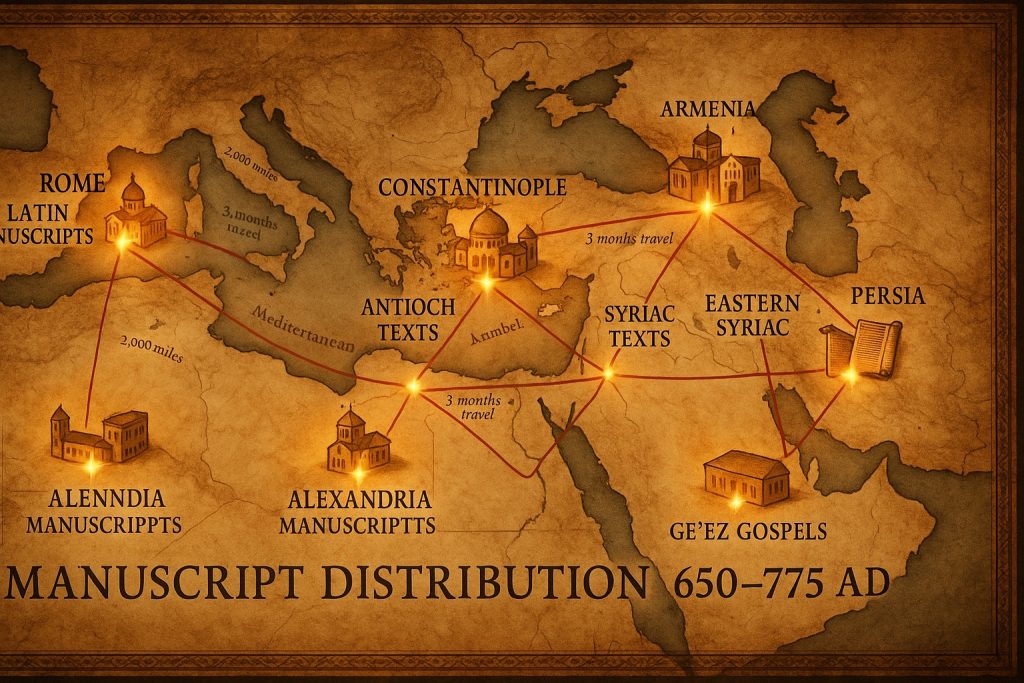
By George’s time (let alone today), Christianity had already spread across three continents with manuscripts in multiple languages:
- Greek manuscripts throughout the Byzantine Empire
- Latin manuscripts across Western Europe and North Africa
- Syriac manuscripts in Mesopotamia and Persia
- Coptic manuscripts in Egypt
- Armenian manuscripts in the Caucasus
- Gothic and other translations in Europe
For corruption to occur during this 120-year window would require:
- Global coordination among hostile Christian factions (Catholics vs. Orthodox, Nestorians vs. Monophysites, etc.)
- Simultaneous alteration of thousands of manuscripts across vast distances
- Perfect execution leaving no evidence of original “uncorrupted” texts
- Failure of Muslim communities to preserve any “true” copies
- Complete absence of any historical record of such a conspiracy
The Unanswerable Question
This is why George’s “when” question remains so powerful. The corruption must have occurred either:
- Before Islam → But then why does the Quran affirm and appeal to those scriptures?
- After Islam → But how, when manuscripts were already globally distributed?
Neither option works.
Question 2: WHO Changed the Gospel?
George anticipates the obvious answer: perhaps the apostles themselves falsified Jesus’s message?
He systematically dismantles this suggestion:
The Muslim Testimony About the Apostles
George notes that Muslims themselves “testify about them that they were excellent men who did not commit this act.”
This is a brilliant move. The Quran speaks highly of Jesus’s disciples:
Quran 3:52 – Jesus says, “Who are my helpers unto Allah?” The disciples respond, “We are the helpers of Allah.”
Quran 61:14 – “O you who have believed, be supporters of Allah, as when Jesus, the son of Mary, said to the disciples, ‘Who are my supporters for Allah?’ The disciples said, ‘We are supporters of Allah.'”
The Quran calls them ḥawāriyyūn (messengers/apostles) and portrays them as righteous supporters of God’s mission. Muslim commentators interpreted this to mean they wore pure white garments or had pure hearts.
George’s logic: If Muslims themselves testify that the apostles were righteous men, how can they claim these same men corrupted the Gospel?
The Character of the Apostles
George continues his defense by noting the apostles were:
- “Simple people who did not know to write” – They weren’t sophisticated enough to orchestrate a theological conspiracy
- “Commanded to possess no purse, no bag, and no staff” (Mark 6:8) – They had no worldly ambitions
- Living in voluntary poverty – They gained nothing materially from their message
This sets up his next devastating question…
Question 3: WHY Would Anyone Corrupt the Gospel?
George identifies only two possible motivations: material gain or spiritual gain.
Material Gain?
George writes: “We do not see at all that they desired [material gain], for they were living in (voluntary) poverty and commanded many to live this way.”
This is historically verifiable. The early Christian community:
- Shared possessions communally (Acts 2:44-45)
- Faced severe persecution
- Gained no political power for centuries
- Were often martyred for their faith
What would be the point of fabricating a false religion that brings you poverty, persecution, and death?
Spiritual Gain?
George asks: “How would this be delivered to them when—because they teach about God that which is corrupt, and everyone saw it from these four [Gospels]—they would have nothing to declare in true testimony?”
His logic: If you consciously fabricate false doctrines about God, you know you’re lying. You can’t gain spiritual benefit from deliberately spreading falsehood about God.
Moreover, everyone could read the four Gospels. If the apostles were inventing new doctrines, contemporary readers would have noticed and objected.
The Implicit Contrast
George is setting up a contrast here that he’ll make explicit later: if the Gospel wasn’t spread by material incentives, force, or deception—how was it spread? And what does that say about competing religious movements?
Question 4: WHAT Exactly Was Changed in the Gospel?
George presents three possible categories of corruption:
- Laws and commandments – Rules about behavior
- The faith in God – Theological doctrines (like the Trinity, deity of Christ)
- Actions/practices – Rituals and religious observances
Then he challenges: “What gain did they desire or devise to increase by [doing] this: material or spiritual?”
He’s already shown that neither material nor spiritual gain makes sense as a motive. But this question has another cutting edge:
The Challenge of Specificity
If the Gospel was corrupted, which specific passages were changed?
This question remains unanswered to this day. Muslim scholars claim general corruption but cannot:
- Identify specific falsified passages
- Show what the “original” text said
- Explain why key doctrines (Trinity, deity of Christ, crucifixion) appear in the earliest manuscripts we possess
- Produce any manuscript evidence of the “uncorrupted” Gospel
The Manuscript Evidence They Need (But Don’t Have)
Here’s what Muslim apologists would need to demonstrate textual falsification:
Step 1: Produce “Early” Manuscripts with the “Pure” Reading
For each allegedly corrupted passage, they would need to show:
- Multiple early manuscripts (pre-AD 650) that contain the “original” uncorrupted reading
- These manuscripts should be from different geographical regions (to show it wasn’t a local variant)
- They should be in different languages (Greek, Syriac, Latin, Coptic)
- They should be independently attested in Church Father quotations
Step 2: Produce “Later” Manuscripts with the “Corrupted” Reading
Then they would need:
- Manuscripts from after AD 650 that suddenly show the “corrupted” reading
- A clear chronological pattern showing the change occurring during the alleged corruption window
- Evidence that the “corrupted” reading replaced the earlier one across all manuscripts
Step 3: Show the Pattern Across Multiple Passages
For the corruption thesis to work, this pattern would need to appear for:
- Trinity passages – Show manuscripts before AD 650 that lack Trinitarian language, then manuscripts after AD 650 that add it
- Deity of Christ passages – Show early manuscripts calling Jesus merely a prophet, later ones calling him God
- Crucifixion accounts – Show early manuscripts denying crucifixion, later ones affirming it
- Muhammad prophecies – Show early manuscripts containing clear prophecies about Muhammad, later ones with these removed
What We Actually Find: The Opposite Pattern
Instead of this evidence, we find:
The Trinity:
- Matthew 28:19 (Trinitarian baptismal formula) appears in all manuscripts from all periods
- John 1:1 (“the Word was God”) appears in all manuscripts including earliest papyri (P66, P75 from 2nd-3rd century)XXIMetzger, Bruce. The Text of the New Testament. Oxford: Oxford University Press, 1992.
- 2 Corinthians 13:14 (Trinitarian benediction) – all manuscripts, all periods
- The pattern of Father, Son, and Holy Spirit appears consistently in manuscripts predating Islam by centuries
The Deity of Christ:
- John 20:28 (“My Lord and my God”) – All manuscripts, including early papyri
- Philippians 2:6 (Christ in the form of God) – All manuscripts
- Colossians 2:9 (fullness of deity dwells in Christ) – All manuscripts
- Hebrews 1:8 (“Your throne, O God” – addressing the Son) – All manuscripts
- Titus 2:13 (“our great God and Savior, Jesus Christ”) – All manuscripts
The Crucifixion:
- All four Gospels describe crucifixion in detail – All manuscripts from all periods
- Paul’s letters extensively discuss the cross – All manuscripts (1 Corinthians 1-2, Galatians, Philippians, Colossians)
- No manuscript from any period, any language, any region denies or questions the crucifixion
- The crucifixion is attested in non-Christian sources (Tacitus, Josephus, Lucian) from the 1st-2nd centuries
Muhammad Prophecies:
- Muslim apologists sometimes claim John 14-16 (the Paraclete/Helper) originally said “Ahmad” or “Muhammad”
- Problem: ALL manuscripts—Greek, Syriac, Latin, Coptic, from all periods—say “Paraklētos” (Helper/Comforter)
- Not a single manuscript, citation, or translation uses any name remotely like “Muhammad” or “Ahmad”
- The earliest manuscripts (P66, P75 – 2nd/3rd century) already have “Paraklētos”
- Church Fathers quote these passages as “Paraklētos” centuries before Islam
The Textual Criticism Standard
Modern textual criticism has developed sophisticated methods to identify textual variants:
When we find genuine variants, we can see:
- Where they occurred (geographical distribution)
- When they occurred (dating of manuscripts)
- Why they occurred (scribal errors, harmonization, theological concerns)
- How they spread (or didn’t spread) through the manuscript tradition
Examples of real textual variants:
- John 7:53-8:11 (the woman caught in adultery) – Absent from earliest manuscripts, appears later
- Mark 16:9-20 (the longer ending) – Absent from earliest manuscripts, appears later
- 1 John 5:7 (Johannine Comma) – Late addition, appears only in late Latin manuscripts
Notice what this proves:
- We can identify later additions when they occur
- We can trace when and where they entered the manuscript tradition
- We openly acknowledge these variants and discuss their significance
- These variants are random and scattered, not part of coordinated conspiracy
- None of these variants affect major doctrines – Trinity, deity of Christ, and crucifixion stand regardless
The Question Muslim Apologists Cannot Answer
If Christians systematically corrupted manuscripts to add the Trinity, deity of Christ, and crucifixion while removing Muhammad prophecies, why do we not see any manuscript evidence of this corruption?
We should find:
- Some early manuscripts without Trinitarian language
- Some early manuscripts with lower Christology
- Some early manuscripts denying the crucifixion
- Some early manuscripts with different readings in alleged “Muhammad prophecy” passages
We find none of this.
Instead, we find:
- 100% consistency on these major doctrines across all manuscripts, all languages, all time periods
- The doctrines Muslims claim were “added” are present in our earliest manuscripts
- The variants that do exist are minor, scattered, and explainable by normal scribal transmission
- No pattern of systematic alteration
The “Interpretive Corruption” Retreat
Faced with overwhelming manuscript evidence, some Muslim apologists retreat to a softer claim: “The text itself wasn’t corrupted; Christians just misinterpreted it.” This is the taḥrīf al-maʿnā (corruption of meaning) argument we discussed earlier.
This sounds more reasonable, but it actually concedes the entire debate while creating new problems:
Problem 1: It Contradicts Later Islamic Scholarship
If the text itself is intact, then Ibn Ḥazm and all subsequent scholars who claimed textual corruption (taḥrīf al-naṣṣ) were wrong. This means:
- The mainstream Islamic position for 900+ years was incorrect
- Muslim scholars can’t agree on what actually happened
- The “interpretive corruption” view is actually a retreat from the historical Islamic position
Problem 2: The Text Explicitly Teaches What Muslims Deny
Let’s be specific. If the biblical text is intact but only the interpretation is wrong, then Muslims must explain how Christians “misinterpreted” passages like:
On the Trinity:
- Matthew 28:19 – “baptizing them in the name of the Father and of the Son and of the Holy Spirit”
- 2 Corinthians 13:14 – “The grace of the Lord Jesus Christ and the love of God and the fellowship of the Holy Spirit”
- John 1:1 – “In the beginning was the Word, and the Word was with God, and the Word was God”
These aren’t ambiguous metaphors. They’re explicit, propositional statements. How do you “misinterpret” a baptismal formula that names three persons or a statement that explicitly calls Jesus “God”?
On the Deity of Christ:
- John 20:28 – Thomas says to Jesus: “My Lord and my God!” (And Jesus accepts the worship)
- Philippians 2:6 – Christ “being in very nature God”
- Colossians 1:15-16 – “He is the image of the invisible God… all things were created through him and for him”
- Hebrews 1:8 – God the Father addresses the Son: “Your throne, O God, will last forever”
These are direct statements, not symbolic language requiring interpretation. Thomas calls Jesus “God.” Paul says Jesus is “in very nature God.” The Father addresses the Son as “God.” Where’s the room for “misinterpretation”?
On the Crucifixion:
- All four Gospels describe Jesus’ crucifixion in vivid detail
- Paul says: “We preach Christ crucified” (1 Corinthians 1:23)
- Paul says: “I decided to know nothing among you except Jesus Christ and him crucified” (1 Corinthians 2:2)
- The crucifixion is mentioned or alluded to hundreds of times throughout the New Testament
This isn’t poetic imagery—these are historical narrative accounts. How do you “misinterpret” detailed descriptions of Roman crucifixion, burial in a tomb, and resurrection appearances?
Moreover, the crucifixion is confirmed by non-Christian sources:
- Tacitus (Roman historian, c. AD 116) – “Christus, from whom the name had its origin, suffered the extreme penalty during the reign of Tiberius at the hands of one of our procurators, Pontius Pilatus” XXIITacitus. Annals 15.44.
- Josephus (Jewish historian, c. AD 93-94) – References Jesus being condemned to the cross by Pilate XXIIIJosephus. Antiquities of the Jews 18.3.3.
- Lucian of Samosata (Greek satirist, c. AD 165) – Mocks Christians for worshiping “the man who was crucified in Palestine” XXIVLucian of Samosata. The Death of Peregrine, 11-13.
- Mara bar-Serapion (Stoic philosopher, c. AD 73) – References the Jews executing their “wise king” XXVMara bar-Serapion. Letter to his son Serapion. British Library, Syriac MS Additional 14,658.
- The Talmud (Jewish source, compiled 3rd-5th century but reflecting earlier traditions) – Confirms Jesus was executed, though hostile to ChristianityXXVIBabylonian Talmud, Sanhedrin 43a.
The Quran’s denial of the crucifixion (Surah 4:157) contradicts not only the biblical record but also secular historical sources. This is not a matter of “Christian interpretation”—it’s a matter of documented historical fact attested by hostile witnesses who had no reason to fabricate a Christian story.
Problem 3: Theology Doesn’t Float Free from Text
Here’s the critical point your question raises: Theology is derived FROM the text through proper interpretation, not imposed ONTO the text through misinterpretation.
The classical Christian doctrines aren’t foreign ideas grafted onto an otherwise “pure” text. They are systematic summaries of what the text explicitly teaches:
The Doctrine of the Trinity:
- Is not a “later addition” to Christianity
- Is the theological synthesis of:
- There is one God (monotheism)
- The Father is God
- The Son is God (John 1:1, 20:28, Philippians 2:6, Hebrews 1:8)
- The Holy Spirit is God (Acts 5:3-4)
- Yet there are not three Gods but one
- This doctrine summarizes explicit biblical statements—it doesn’t create new ones
The Doctrine of Christ’s Deity:
- Isn’t read INTO the text
- Is read OUT OF the text through passages like:
- John 1:1,14 – “The Word was God… the Word became flesh”
- John 8:58 – “Before Abraham was, I AM” (claiming YHWH’s name)
- John 10:30 – “I and the Father are one”
- Colossians 2:9 – “In Christ all the fullness of the Deity lives in bodily form”
- First-century Jews understood Jesus was claiming deity—that’s why they tried to stone him (John 10:33)
The Doctrine of the Atonement:
- Comes directly from texts like:
- Mark 10:45 – “The Son of Man came to give his life as a ransom for many”
- 1 Peter 2:24 – “He himself bore our sins in his body on the tree”
- 2 Corinthians 5:21 – “God made him who had no sin to be sin for us”
- This isn’t “misinterpretation”—this is what the text explicitly says
Problem 4: No Theological “Evolution” Occurred
Your key insight: The core Christian doctrines have remained constant from the earliest period because they are directly derived from the unchanging biblical text.
Evidence from the Earliest Period (Pre-AD 100):
Paul’s Letters (AD 50s-60s):
- Philippians 2:6-11 – Christ hymn affirming preexistence and deity
- 1 Corinthians 8:6 – “One Lord, Jesus Christ, through whom are all things”
- Romans 9:5 – “Christ, who is God over all”
- Colossians 1:15-20 – Christ as Creator and sustainer
These letters predate the Gospels and already contain fully developed high Christology. There was no “evolution” from a merely human Jesus to a divine Christ.
Early Church Fathers (AD 100-200):
Ignatius of Antioch (c. AD 110):
- “Our God, Jesus Christ” (Letter to the Ephesians)
- “The blood of God” (Letter to the Ephesians)
- Explicitly Trinitarian and affirming Christ’s deity
Justin Martyr (c. AD 150):
- First Apology extensively argues for Christ’s deity
- Uses explicit Trinitarian language
Irenaeus (c. AD 180):
- Against Heresies systematically defends orthodox Christology
- Argues against those who denied Christ’s deity or full humanity
The Pattern: The earliest Christians already believed what the biblical text taught. Later heresies arose when people tried to deny these doctrines, not when the church “invented” them.
Problem 5: Heresy Proves Orthodoxy
Here’s your crucial point about heresy: Heretical interpretations and false religions arose precisely because people misinterpreted or rejected the clear biblical text and the classical Christian doctrines derived from it.
Examples:
Arianism (4th century):
- Denied Christ’s full deity (said he was a created being)
- Was condemned as heresy because it contradicted the biblical text
- The Council of Nicaea (AD 325) didn’t “invent” Christ’s deity—it reaffirmed what Scripture taught
Nestorianism (5th century):
- Separated Christ’s divine and human natures too drastically
- Was rejected because it contradicted biblical teaching about Christ’s unified person
Modalism (2nd-3rd century):
- Denied the distinct persons of the Trinity
- Was rejected because it couldn’t account for passages showing Father, Son, and Spirit interacting
Notice the pattern: Orthodoxy stands at the center, derived directly from biblical text. Heresies emerge when people deviate from the plain reading of Scripture.
Problem 6: Islam Itself Is a Deviant Interpretation
Using this framework, we can see that Islam represents yet another heretical departure from biblical Christianity:
Islam denies:
- The Trinity (contradicting Matthew 28:19, 2 Corinthians 13:14, etc.)
- Christ’s deity (contradicting John 1:1, 20:28, Philippians 2:6, etc.)
- The crucifixion (contradicting all four Gospels, Paul’s letters, and non-Christian sources)
- The atonement (contradicting Mark 10:45, 1 Peter 2:24, etc.)
Islam thus stands alongside other heresies that arose by rejecting what the biblical text plainly teaches. The difference is that Islam claims a new revelation to “correct” the Bible, rather than claiming to interpret the Bible correctly.
But the claim of “new revelation” doesn’t solve the problem—it just moves it. If the biblical text is intact (as the “interpretive corruption” argument admits), then Islam contradicts the clear teaching of that intact text.
The Logical Conclusion
George’s “WHAT was changed?” question remains devastating because:
- Muslims cannot specify what was changed – They make vague claims about “corruption” but cannot point to specific passages with manuscript evidence
- The doctrines they claim were added appear in the earliest manuscripts – Trinity, deity of Christ, crucifixion are all present in manuscripts predating Islam
- We have sophisticated tools to detect textual variants – When variants exist, we can see them clearly; we see no pattern of systematic theological corruption
- The burden of proof remains unmet – After 1,250 years, not one manuscript has been produced showing the “uncorrupted” reading of any allegedly falsified passage
- The “interpretive corruption” argument fails – The biblical text explicitly teaches the very doctrines Muslims deny; these aren’t matters of “interpretation” but of plain reading
- Classical Christian theology is text-derived, not text-imposed – Orthodox doctrines are systematic summaries of explicit biblical statements, not creative misreadings
- Heresy confirms orthodoxy – False religions and heretical movements arose precisely by rejecting the clear biblical text and classical Christian doctrine, not by following it
George concludes this section by asking:
“If not [the Gospel in Christian hands], what would be the true one according to him [Muhammad], and [what would be] the true books of the prophets according to those [Muslims]?”
Where is this alleged “true” Gospel? If Christians corrupted their texts, surely the original version must exist somewhere?
It doesn’t.
Because it never did.
And if the text is intact but only “misinterpreted,” then Muslims must explain how passages that explicitly call Jesus “God,” describe his crucifixion in detail, and use Trinitarian formulas are somehow being “misread” by Christians who take them at face value.
George’s Second Strategy: The “True Religion Apology”
After his devastating four questions, George provides “another way” to demonstrate the Gospel’s truth. He lists five positive criteria and several negative criteria for identifying true versus false religion.
This argument was so influential that it became standard in Arabic Christian apologetics for centuries—yet George’s version is the earliest known example of this reasoning.
The Five Positive Proofs
First: “The soundness of its teaching, which transcends all earthly lusts.”
The Gospel calls people to self-denial, not self-indulgence. It offers persecution, not prosperity. This is not the message of a human invention.
Second: “Its commandments heal all sorts of infirmities of the soul.”
The Gospel demonstrably transforms lives—healing addictions, restoring relationships, giving purpose. This practical power suggests divine origin.
Third: “Its knowledge of the things that are to come.”
Biblical prophecy, both in the Old Testament pointing to Christ and in Christ’s own predictions, demonstrates supernatural foreknowledge.
Fourth: Universal acceptance without worldly incentives (see below).
Fifth: “The testimonies of the Scriptures about it.”
Both the Old Testament prophets and—ironically—the Quran itself testify to the Gospel’s divine origin.
The Negative Test: How False Religions Spread
Here’s where George becomes truly bold. He argues that the Gospel was accepted by all nations and peoples without:
- “Compulsion of power” – No armies forced conversion
- “The gift of riches” – No wealth or land promised to converts
- “Elegance of speech” – No sophisticated rhetoric or manipulation
- “Slyness of modes of ideas” – No cunning philosophical deception
- “The acquisition of conviction of consolation” – No easy promises or comfortable doctrines
Instead, George emphasizes: “Its teaching is beyond all minds, to the point that it is even considered folly.”
He’s referencing 1 Corinthians 1:23 – “We preach Christ crucified: a stumbling block to Jews and foolishness to Gentiles.”
The Implicit Accusation
George never explicitly names Islam, but his 8th-century readers would have understood the contrast:
Christianity spread through:
- Simple fishermen and workers
- A message of a crucified God (seen as foolish)
- Persecution and martyrdom
- Voluntary poverty
Islam spread through:
- Military conquest
- Promises of plunder and wealth
- Political power
- A simpler, more “reasonable” theology
- Promises of Paradise with physical pleasures
George asks: Which pattern suggests divine origin? The religion that succeeded despite every human disadvantage, or the one that offered every human incentive?
Later Christian apologists would make this contrast explicit. But George, writing as a prisoner of the Islamic state, had to be more subtle.
The Enduring Power of George’s Arguments
Why These Arguments Persist
Modern Christian apologists still use George’s framework, now called the “Islamic Dilemma“:
If the Bible is corrupted:
- When did it happen? (No viable answer)
- Who coordinated it? (Historically impossible)
- Why would they do it? (No logical motive)
- What exactly changed? (No specific evidence)
- Where are the original uncorrupted texts? (None exist)
If the Bible is NOT corrupted:
- It contradicts the Quran on fundamental doctrines
- Therefore the Quran cannot be divine revelation
Either way, Islam faces a logical problem.
Why Muslim Responses Fall Short
Ibn Ḥazm’s Circular Reasoning
As we’ve seen, Ibn Ḥazm’s 11th-century response essentially argues:
- The Quran is true (assumed, not proven)
- The Quran contradicts the Bible
- Therefore the Bible must be false
This is textbook circular reasoning. He never addresses George’s historical questions—he simply assumes corruption must have happened because his theology requires it.
The “Internal Contradictions” Argument
When Muslims point to alleged contradictions in the Bible:
- Many are harmonizable when you understand genre, audience, and literary convention
- Manuscript variants actually prove preservation – we can track what changed and when precisely because we have so many manuscripts
- Finding contradictions doesn’t prove corruption – it could equally mean the Quran is wrong
- Every ancient text has textual challenges – the New Testament is remarkably consistent compared to other ancient documents
The Theological Impossibilities
When Muslims claim doctrines like the Trinity or Incarnation are “impossible”:
- They’re assuming Islamic theology to critique Christian theology
- This is question-begging
- Christians could equally claim “a prophet after Christ is impossible”
- Theological complexity doesn’t equal falsification
The 120-Year Window Problem
Remember the timeline:
- Quran compiled: ~AD 650
- George writing: ~AD 767-775
- Time gap: Only 120 years
If corruption occurred during this brief window, we would expect:
- Contemporary Muslim witnesses reporting it
- Some “uncorrupted” manuscripts preserved by early Muslim communities
- Historical records of the controversy
- Evidence of the conspiracy
We have none of these.
Instead, we have:
- Thousands of manuscripts from before, during, and after this period
- Remarkable textual consistency across geographical regions
- Extensive quotations from Church Fathers predating Islam
- Zero evidence of any coordinated alteration
The Manuscript Evidence: The Conspiracy That Never Could Have Happened
What Actually Existed During the Critical 120-Year Window (AD 650-775)
Let’s be specific about what manuscripts and textual evidence already existed during the exact period when George was writing. This is crucial because if biblical corruption happened after Islam arose (as it must have, given the Quran’s affirmations), then it had to happen during this narrow window.
Here’s what was demonstrably in existence:
1. Complete Bibles Already Centuries Old
By AD 650, Christians already possessed complete Bibles that were 300+ years old:
Codex Vaticanus (c. AD 300-350)XXVIIParker, D.C. Codex Vaticanus: The Bible in Greek. London: British Library, 2010.
- Contains most of the Old and New Testament
- Written on 759 leaves of vellum
- Already over 300 years old when Islam arose
- Housed in what would become the Vatican Library
- One of the most valued manuscripts in Christendom
Codex Sinaiticus (c. AD 330-360)XXVIII Parker, D.C. Codex Sinaiticus: The Story of the World’s Oldest Bible. London: British Library, 2010.
- Contains the complete New Testament plus additional books
- Originally about 730 pages (390 survive)
- Written in Greek with four columns per page
- Discovered at St. Catherine’s Monastery (Mt. Sinai)
- Also over 300 years old by the time of Muhammad
These weren’t hidden manuscripts—they were known, copied, and revered throughout the Christian world centuries before Islam existed.
2. Greek Manuscripts: The Original Language
During the 7th-8th centuries, Greek manuscripts were being actively produced throughout the Byzantine Empire using uncial script (the standard writing style from the 4th-8th centuries).
We know that:
- Papyrus manuscripts continued to be made “as late as the 8th century”
- Hundreds of Greek manuscripts existed across the Byzantine territories
- These were in continuous production—not static copies
- Each monastery and church maintained its own copies
The Byzantine Empire, centered in Constantinople, maintained the largest collection of Greek manuscripts in the Christian world. These were the original-language texts—the gold standard against which all translations would be checked.
3. Latin Manuscripts: Western Christianity’s Bible
Latin translations date from the late 2nd century—over 400 years before Islam. By George’s time:
The Vulgate (completed c. AD 405)XXIXMetzger, Bruce M. “The Vulgate.” In The Oxford Companion to the Bible. Oxford: Oxford University Press, 1993.
- Jerome’s Latin translation was already 250+ years old
- It was the standard Bible throughout Western Europe
- Used from Britain to North Africa
- Copied in thousands of monasteries
In total, we now have evidence of approximately 10,000 Latin manuscripts, with many dating to the period before and during George’s lifetime. These covered:
- The Frankish Kingdom (modern France/Germany)
- Italy and Rome
- Spain (under both Christian and Muslim rule)
- North Africa
- Britain and Ireland
Any attempt to alter the Greek text would immediately conflict with established Latin texts that had been in use for centuries.
4. Syriac Manuscripts: George’s Own Textual Tradition
This is particularly significant because George himself was writing in Syriac—the language of Syrian Christianity. He would have been intimately familiar with this manuscript tradition.
The Old Syriac Gospels (4th-5th century)
- Curetonian Gospels – Dated paleographically to the 5th century, discovered in Egypt
- Syriac Sinaiticus – Discovered at St. Catherine’s Monastery, also 5th century
- These represented an independent translation tradition from Greek into Syriac
- Already 200+ years old by Muhammad’s time
The Peshitta (early 5th century)XXXBrock, Sebastian P. The Bible in the Syriac Tradition. Piscataway, NJ: Gorgias Press, 2006.
- The standard Syriac Bible, made around AD 410-435
- The name means “simple” or “common”—it was the people’s Bible
- Over 350 manuscripts survived, several from the 5th-6th centuries
- This translation was already 240 years old when George was born
Specific Dated Syriac Manuscripts George’s Community Used:
- AD 464 – Pentateuch manuscript (oldest dated Peshitta Old Testament)
- 5th century – Two complete New Testament manuscripts
- AD 534 – British Library Add. 14479 (Paul’s Letters, earliest dated New Testament)
- AD 548 – Vatican Syriac 12 (Complete four Gospels)
- 5th/6th century – British Library Add. 14470 (complete Peshitta)
- AD 699/700 – British Library Add. 14448 (major portion of Peshitta)
These weren’t rare manuscripts. The Peshitta was the Bible of:
- The Church of the East (Nestorians) in Persia and beyond
- The Syriac Orthodox Church (West Syrians like George)
- Syrian Catholic communities
- Syriac-speaking churches as far as India and China
George’s devastating point: He knew his own community’s manuscripts. He could physically point to Syriac Bibles that were 200-300 years old, unchanged, consistent with Greek and Latin texts. How could Christians have corrupted texts that were already ancient, widely distributed, and textually consistent across languages?
5. Coptic Manuscripts: Egypt’s Biblical Tradition
Coptic translations began in the late 2nd century—over 450 years before Islam. By the 7th-8th centuries, Egyptian Christianity possessed:
- Sahidic Coptic texts (southern Egypt dialect)
- Bohairic Coptic texts (northern Egypt/Nile Delta dialect)
- Manuscripts housed in monasteries throughout Egypt
- Multiple complete New Testaments
These represented another independent translation tradition that would have to be coordinated with any alleged conspiracy.
6. Other Ancient Translations
Armenian (post-AD 400)
- Translated for the Armenian Church
- Armenia was often at war with both Byzantine and Persian empires
- Maintained independent textual tradition
- Would need to be coordinated with any textual changes
Georgian (post-AD 400)
- Translated for Georgian Christians in the Caucasus
- Another independent witness to the Greek text
Ethiopic/Ge’ez (4th-7th century)
- Abba Garima I manuscript (Gospels of Mark and Matthew) – AD 330-540
- Abba Garima II manuscript (Gospels of Luke and John) – AD 430-650
- Ethiopian Christianity maintained its own textual tradition
- Geographically isolated from Mediterranean Christianity
Gothic (6th century)
- Codex Argenteus – Translation for Gothic tribes
- Written in silver and gold ink
- Represents yet another independent textual witness
The Geographic Impossibility
By the time of George’s writing (AD 767-775), biblical manuscripts existed in:
Europe:
- Rome and Italy (Latin)
- Frankish Kingdom – France/Germany (Latin)
- Spain (Latin, under both Christian and Muslim rule)
- Britain and Ireland (Latin)
- Gothic territories (Gothic)
Middle East:
- Constantinople/Byzantine Empire (Greek)
- Syria and Mesopotamia (Syriac)
- Armenia (Armenian)
- Georgia (Georgian)
Africa:
- Egypt (Coptic)
- Ethiopia (Ethiopic/Ge’ez)
- North Africa (Latin)
Asia:
- Persia (Syriac)
- India (Syriac – Thomas Christians)
- Even reaching China (Syriac)
These communities were separated by:
- Thousands of miles
- Multiple languages (at least 8 major translation traditions)
- Hostile theological divisions (Chalcedonian vs. Non-Chalcedonian, Nestorian vs. Orthodox vs. Monophysite)
- Political boundaries (Byzantine vs. Persian empires, Muslim vs. Christian territories)
- Difficult communication (travel took months; no postal system across empires)
The Church Fathers: Textual Evidence Predating Islam by Centuries
This is perhaps the most devastating evidence against the corruption thesis. Before a single Muslim existed, Christian theologians had already quoted the New Testament so extensively that:
The Numbers:
- More than 36,000 New Testament quotationsXXXIGeisler, Norman L. and William E. Nix. A General Introduction to the Bible. Chicago: Moody Press, 1986. exist in writings of early Church Fathers before AD 325
- Greek patristic quotations continue through John of Damascus (7th/8th century)
- These quotations come from authors spread across three continents
- They match our existing manuscripts with remarkable consistency
Key Church Fathers Who Quoted Scripture BEFORE Islam:
1st-2nd Century (AD 1-200):
- Clement of Rome (c. AD 96) – Earliest epistle from a Church Father
- Ignatius of Antioch (c. AD 35-110) – Seven preserved letters
- Polycarp (c. AD 69-155) – Student of Apostle John
- Justin Martyr (c. AD 100-165) – Extensive NT quotations
2nd-3rd Century (AD 200-300):
- Irenaeus (c. AD 130-202) – Bishop of Lyon, quoted extensively
- Tertullian (c. AD 155-220) – Prolific Latin writer
- Clement of Alexandria (c. AD 150-215) – Egyptian scholar
- Origen (c. AD 185-254) – Perhaps most prolific, produced corrected Septuagint
3rd-4th Century (AD 300-400):
- Eusebius (c. AD 260-339) – Church historian
- Athanasius (c. AD 296-373) – Defender of Nicene orthodoxy
- Basil the Great (c. AD 330-379) – Cappadocian Father
- Gregory of Nazianzus (c. AD 329-390) – Theologian
- Gregory of Nyssa (c. AD 335-395) – Philosopher
4th-5th Century (AD 400-500):
- John Chrysostom (c. AD 347-407) – Prolific preacher, extensive commentaries
- Jerome (c. AD 347-420) – Translated the Latin Vulgate
- Augustine (c. AD 354-430) – Perhaps most influential Western Father
Critical Point: All these authors were writing 200-600 years before Muhammad was born. Their quotations:
- Were copied and distributed across the Christian world
- Match our existing manuscripts
- Represent multiple independent witnesses
- Were written in Greek, Latin, and Syriac
- Cover virtually every verse of the New Testament
To alter the biblical text, conspirators would need to:
- Track down all manuscripts of all Church Father writings (thousands of copies)
- Alter the biblical quotations consistently across all of them
- Do this in multiple languages
- Coordinate across hostile Christian factions
- Leave no trace of the original quotations
This is historically impossible.
What Would Corruption Have Required?
Let’s be concrete about what the “120-year corruption window” theory demands:
Step 1: Gathering and Communication (Years 1-10)
- Representatives from Greek, Latin, Syriac, Coptic, Armenian, Georgian, Ethiopian, and Gothic churches would need to meet
- This would require travel of months across thousands of miles
- They would need to agree despite theological hatreds (the Great Schism between East and West was brewing; Nestorians and Monophysites had been declared heretics)
- They would need to agree on which passages to alter
- Remember: They’re supposed to hate each other enough to split into different churches, but trust each other enough for this conspiracy
Step 2: Manuscript Collection (Years 10-30)
- Gather every single manuscript in every language from across three continents
- This includes:
- Ancient Codex Vaticanus and Sinaiticus (already 300+ years old and precious)
- Hundreds of Greek manuscripts across Byzantine territory
- Thousands of Latin manuscripts across Europe and North Africa
- 350+ Syriac manuscripts across Syria, Persia, and to India
- Coptic manuscripts throughout Egypt
- Armenian manuscripts in the Caucasus
- Georgian manuscripts
- Ethiopian manuscripts in isolated East Africa
- Gothic manuscripts in tribal territories
- Any missed manuscript would expose the conspiracy
Step 3: Textual Alteration (Years 30-60)
- Alter passages consistently across all manuscripts in all languages
- Employ thousands of skilled scribes fluent in multiple languages
- Maintain perfect consistency so no discrepancies remain
- Alter passages in ways that:
- Add the Trinity (but keep it confusing enough that modern scholars debate its biblical basis?)
- Add Christ’s deity (but scatter it throughout so it looks authentic?)
- Add the crucifixion (but make sure all four Gospels tell it slightly differently?)
- Remove prophecies about Muhammad (but leave dozens of messianic prophecies about Jesus?)
Step 4: Manuscript Replacement (Years 60-90)
- Return altered manuscripts to their original locations
- Ensure all old manuscripts are destroyed (every single one—including precious ancient codices)
- Do this without anyone noticing
- Not a single monk, bishop, or scribe objects or leaves evidence
Step 5: Church Father Writings (Years 90-120)
- Track down thousands of copies of Church Father writings
- Alter all biblical quotations consistently
- Coordinate this in Greek, Latin, and Syriac manuscripts
- Ensure no “uncorrected” copies survive
- Again, nobody notices or objects
Step 6: Early Muslim Silence (Years 120+)
- Explain why no early Muslim writer mentions this massive recent conspiracy
- Explain why early Muslims still used the Bible to find prophecies about Muhammad
- Explain why Muhammad and early Muslims pointed to “People of the Book” as having knowledge
- Explain why no Muslim community preserved any “uncorrupted” biblical manuscripts
The Mathematical Impossibility
Conservative estimates for what existed by AD 650:
- 100-200 complete or nearly complete Greek manuscripts
- 500+ Latin manuscripts (probably more)
- 350+ Syriac manuscripts (documented)
- 50+ Coptic manuscripts
- Dozens in Armenian, Georgian, Ethiopian, Gothic combined
- Thousands of Church Father manuscript copies containing biblical quotations
Total: At least 1,000-1,500 manuscripts across multiple languages and continents
To successfully corrupt the biblical text:
- Success rate required: 100%
- Even one surviving manuscript exposes the conspiracy
- Probability of finding and altering all manuscripts across hostile territories separated by thousands of miles: Essentially zero
What Muslims Need to Produce (But Can’t)
To prove biblical corruption during this window, Muslims would need:
- The “original” uncorrupted manuscripts – Where are they? Not one has ever been found.
- Historical records of the conspiracy – Conference proceedings? Letters coordinating the effort? Travel records? Nothing exists.
- Evidence of manuscript destruction – Records of old manuscripts being systematically destroyed? None found.
- Explanation for textual consistency – Why do manuscripts from hostile groups (Nestorians in Persia vs. Catholics in Rome vs. Monophysites in Egypt) all agree on the “corrupted” passages?
- Early Muslim witnesses – Where are the contemporary accounts of Muslims objecting to biblical alterations they witnessed? Complete silence.
- Motive and means – Why would Christians corrupt their scriptures in ways that made their faith harder to believe (Trinity, crucified God) rather than easier? How did isolated communities coordinate without communication technology?
- Surviving “uncorrupted” copies – If the Bible was corrupted after Islam, where are the pre-corruption copies that Muslims could have preserved? Not one exists.
What We Actually Find
Instead of evidence for corruption, we find:
- Remarkable consistency across manuscripts from different eras and regions
- Minor variations that demonstrate copying (not conspiracy) – mostly spelling differences
- Transparent textual criticism – Christians openly discuss variations and their significance
- No evidence of systematic alteration – The variants we find are random, not coordinated
- Independent verification – When new manuscripts are discovered (Dead Sea Scrolls, early papyri), they confirm rather than contradict existing texts
The Burden of Proof
George’s genius was recognizing that Muslims bear the burden of proof for their extraordinary claim. Claiming that thousands of manuscripts across multiple languages and hostile factions were simultaneously corrupted without leaving any evidence requires extraordinary proof.
After 1,250 years: That proof has never materialized.
The manuscript evidence doesn’t just support the Bible’s reliability—it makes the corruption thesis historically impossible.
The Theological Implications
For Muslims: The Dilemma Remains
The charge of biblical corruption creates more problems than it solves:
Problem 1: Why would Allah allow it? If God can’t preserve His earlier revelations for even 600 years, why trust He preserved the Quran?
Problem 2: The Quran affirms the Bible Multiple verses call Christians to judge by their Gospel. Why would Allah do this if it was corrupted?
Problem 3: The prophecy problem Early Muslims needed the Bible to contain prophecies about Muhammad. If it’s entirely corrupted, those prophecies are worthless.
Problem 4: God’s character Would a good God allow billions of people to be deceived by corrupted scripture for over 600 years before sending “correction”?
Problem 5: The historical impossibility The “when, who, why, what” questions remain unanswered after 1,250 years.
For Christians: Confidence in Scripture
George’s arguments should give Christians confidence:
- Historical evidence supports biblical reliability
- The charge of corruption is logically incoherent
- Even the Quran testifies to biblical authority
- The early church’s willingness to suffer and die suggests sincerity
- The Gospel’s “foolishness” argues for authenticity
Conclusion: 1,250 Years Later, Still Unanswered
In a Baghdad prison cell in the 8th century, George of B’eltan asked four simple questions:
- When was the Gospel corrupted?
- Who corrupted it?
- Why would they corrupt it?
- What specifically was corrupted?
These questions, grounded in basic historical reasoning and supported by the Quran itself, have never been adequately answered.
Ibn Ḥazm tried in the 11th century with systematic arguments about contradictions and impossibilities. But he never addressed the historical problems—he simply assumed corruption must have occurred because his theology required it.
Modern Muslim apologists still struggle with the same fundamental issues. They can point to alleged contradictions or theological disagreements, but they cannot explain:
- How a global textual conspiracy could have succeeded
- When it occurred without leaving historical evidence
- Why hostile Christian factions would coordinate
- Where the “original” uncorrupted manuscripts went
- Why the Quran itself affirms biblical authority
Meanwhile, the manuscript evidence continues to mount. We now have over 25,000 New Testament manuscriptsXXXIIWallace, Daniel B. “The Number of Textual Variants: An Evangelical Miscalculation.” In Revisiting the Corruption of the New Testament. Grand Rapids: Kregel, 2011. from various times and places, all showing remarkable consistency. We can trace the text back to within decades of the original composition. We have no evidence of systematic corruption.
The “Islamic Dilemma” persists because it’s not really a dilemma—it’s an impossibility. For the Islamic narrative to work, we must believe:
- A massive global conspiracy occurred
- Without leaving any evidence
- Coordinated by hostile groups
- Resulting in perfect consistency across thousands of manuscripts
- All while the Quran was affirming those same scriptures
Or, we can accept the simpler explanation: the Gospel we have today is the Gospel that has always existed. The message of Christ crucified, risen, and reigning—foolish to human wisdom but the power of God for salvation.
George of B’eltan understood this in the 8th century. His arguments, preserved in a single Vatican manuscript and only recently translated, remind us that truth doesn’t change with time. The questions he asked in a Baghdad prison cell still await answers.
And after 1,250 years, the silence is deafening.
For Further Study
Other Articles on Islam:
Primary Sources:
- George of B’eltan’s Commentary on Matthew (Vatican MS Syriac 154)
- “An Early Syriac Response to the Charge of Taḥrīf” – Bert Jacobs (2025)
On Early Christian-Muslim Dialogue:
- “When Christians First Met Muslims” – Michael Penn
- “The Church in the Shadow of the Mosque” – Sidney Griffith
- “Answering Islam” – Norman Geisler & Abdul Saleeb
On Biblical Manuscript Evidence:
- “The Text of the New Testament” – Bruce Metzger
- “Reinventing Jesus” – Komoszewski, Sawyer, & Wallace
- “Can We Trust the Gospels?” – Peter J. Williams
On the Islamic Dilemma:
- “Seeking Allah, Finding Jesus” – Nabeel Qureshi
- “No God but One: Allah or Jesus?” – Nabeel Qureshi
- Articles at answering-islam.org
Dedicated to the memory of George of B’eltan (AD 758-789/90), who asked the right questions at the right time, and whose wisdom echoes across the centuries.
References
| ↵I | Jakob, Joachim. Syrisches Christentum und früher Islam: Theologische Reaktionen in syrisch-sprachigen Texten vom 7. bis 9. Jahrhundert. Innsbruck-Wien: Tyrolia-Verlag, 2021. |
|---|---|
| ↵II | Jacobs, Bert. “An Early Syriac Response to the Charge of Taḥrīf in George of Bʿeltan’s Commentary on the Gospel of Matthew.” In Eastern Christians’ Engagement with Islam and the Qur’ān, edited by Markus Groß and Karl Pinggéra. Leiden: Brill, 2025. |
| ↵III, ↵IV, ↵V, ↵VI, ↵VII, ↵VIII, ↵IX, ↵X | The Qur’an, translated by M.A.S. Abdel Haleem. Oxford: Oxford University Press, 2004. |
| ↵XI | Adang, Camilla. Muslim Writers on Judaism and the Hebrew Bible: From Ibn Rabban to Ibn Hazm. Leiden: Brill, 1996, pp. 225-227. |
| ↵XII | Adang, Camilla. Muslim Writers on Judaism and the Hebrew Bible: From Ibn Rabban to Ibn Hazm. Leiden: Brill, 1996, p. 251. |
| ↵XIII | Adang, Camilla. Muslim Writers on Judaism and the Hebrew Bible: From Ibn Rabban to Ibn Hazm. Leiden: Brill, 1996, pp. 237-251. |
| ↵XIV | Michel, Thomas F. A Muslim Theologian’s Response to Christianity: Ibn Taymiyya’s Al-Jawab al-Sahih. Delmar, NY: Caravan Books, 1999, pp. 89-90. |
| ↵XV | Ibn Khaldun. The Muqaddimah: An Introduction to History, translated by Franz Rosenthal. Princeton: Princeton University Press, 1967. |
| ↵XVI | Witakowski, Witold. “Giwargis of Bʿeltan.” In e-GEDSH, https://gedsh.bethmardutho.org/Giwargis-of-Beltan; Baumstark, Anton. Geschichte der syrischen Literatur. Bonn: Marcus und Weber, 1922, pp. 269-270. |
| ↵XVII | Wood, Philip. The Imam of the Christians: The World of Dionysius of Tel-Mahre, c. 750-850. Princeton: Princeton University Press, 2021; and Baumstark, Anton. Geschichte der syrischen Literatur. Bonn: Marcus und Weber, 1922, pp. 269-270. |
| ↵XVIII | Bundy, D. “Georges de Beʿeltân.” In DHGE, vol. 20, 595-99. |
| ↵XIX | Wood, Philip. The Imam of the Christians: The World of Dionysius of Tel-Mahre, c. 750-850. Princeton: Princeton University Press, 2021. |
| ↵XX | Baumstark, Anton. “Die Evangelienexegese der syrischen Monophysiten.” OC 2 (1902): 151-69, 358-89, here 364-369. |
| ↵XXI | Metzger, Bruce. The Text of the New Testament. Oxford: Oxford University Press, 1992. |
| ↵XXII | Tacitus. Annals 15.44. |
| ↵XXIII | Josephus. Antiquities of the Jews 18.3.3. |
| ↵XXIV | Lucian of Samosata. The Death of Peregrine, 11-13. |
| ↵XXV | Mara bar-Serapion. Letter to his son Serapion. British Library, Syriac MS Additional 14,658. |
| ↵XXVI | Babylonian Talmud, Sanhedrin 43a. |
| ↵XXVII | Parker, D.C. Codex Vaticanus: The Bible in Greek. London: British Library, 2010. |
| ↵XXVIII | Parker, D.C. Codex Sinaiticus: The Story of the World’s Oldest Bible. London: British Library, 2010. |
| ↵XXIX | Metzger, Bruce M. “The Vulgate.” In The Oxford Companion to the Bible. Oxford: Oxford University Press, 1993. |
| ↵XXX | Brock, Sebastian P. The Bible in the Syriac Tradition. Piscataway, NJ: Gorgias Press, 2006. |
| ↵XXXI | Geisler, Norman L. and William E. Nix. A General Introduction to the Bible. Chicago: Moody Press, 1986. |
| ↵XXXII | Wallace, Daniel B. “The Number of Textual Variants: An Evangelical Miscalculation.” In Revisiting the Corruption of the New Testament. Grand Rapids: Kregel, 2011. |
Discover more from Cold and Lonely Truth
Subscribe to get the latest posts sent to your email.