


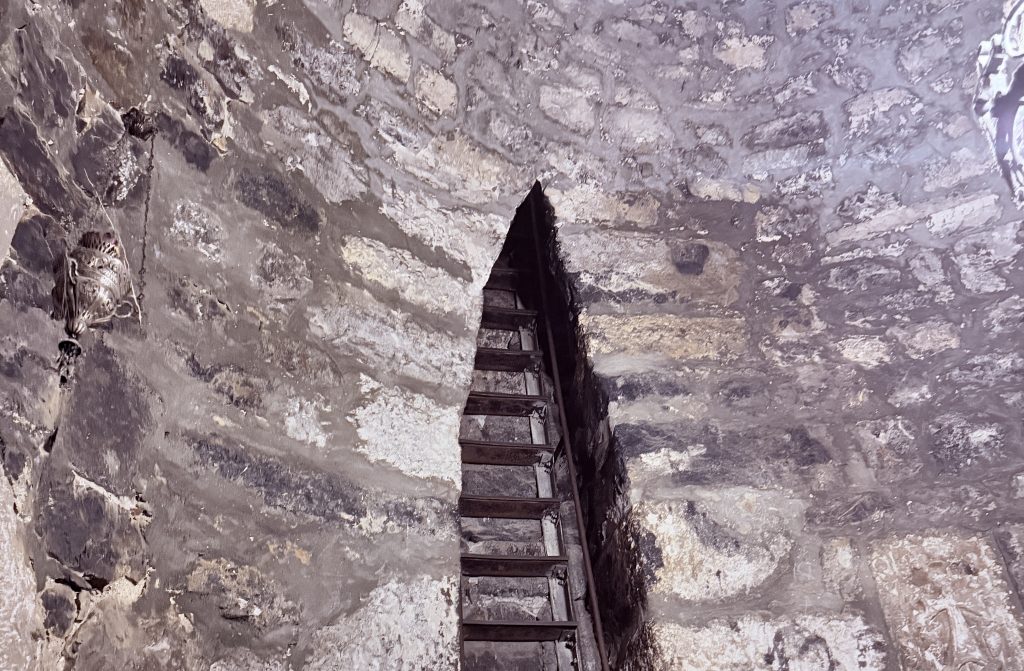
The ladder is steel, bolted to the rock, installed in the last century so that people like me could climb down without breaking our necks. I went down anyway. Six meters into the ground beneath a small chapel on a hill in the Ararat plain in Armenia, into a chamber shaped like the inside of a stone jar, warm and close and unlit. This is Khor Virap. The name means “deep pit.” And by every account the Armenian Church has carried for seventeen hundred years, a man was lowered into this dark and left to die, and instead of dying he walked back out and changed the fate of a nation.
I wanted to know how. Not the pious shorthand, but the actual mechanism, the thing that has to be true underneath the story: how a prisoner at the bottom of a hole ends up the founder of the first kingdom on earth to make Christianity its faith. Stand down there in the dark and the question stops being abstract. A man was in this ground. Something got him out. And whatever it was, it was strong enough to turn a nation over.
The story a nation has told for seventeen centuries
In the late third century Armenia was a pagan kingdom pinned between Rome and Persia, and its throne belonged to Trdat, a hard and capable king. In his court served a man named Gregory, and between the two of them lay a wound: Gregory was the son of the very man who had murdered Trdat’s father. When the king discovered it, and discovered besides that Gregory was a Christian who would not sacrifice to the goddess Anahit, he had him tortured through a catalog of horrors and then thrown into the pit at Artashat, the dungeon of the condemned, and left to rot. Gregory was in that pit, the tradition says, for thirteen years, kept alive by a widow who dropped bread to him in the dark.
Above ground, the king went on being a king. He martyred a company of Christian virgins who had fled to Armenia, Hripsime and Gayane and their companions, and it is here the story turns strange, because the tradition holds that the crime broke him. Trdat was struck down into madness, reduced, the account says, to something less than a man, roaming like a beast. His own priests and physicians could do nothing. Then the king’s sister came to the court with a dream she could not shake: the prisoner in the pit, the one everyone assumed long dead, was the only man alive who could heal the king. They went to Artashat and let down a rope, and after thirteen years in the ground, Gregory came up.
He healed the king. And Trdat, a man who had spent his reign killing Christians, rose from his affliction and bent his whole kingdom toward the God of the man he had buried alive. Gregory was sent to Caesarea to be consecrated bishop and came back to build a church. The tradition gives him a vision to mark the spot: Christ descending from heaven in light, striking the earth with a golden hammer where the cathedral was to rise. They built it there, at Vagharshapat, and called the place Etchmiadzin, “the descent of the Only-Begotten.” The date the church remembers is AD 301. Armenia had become the first nation on earth to take Christ for its own.
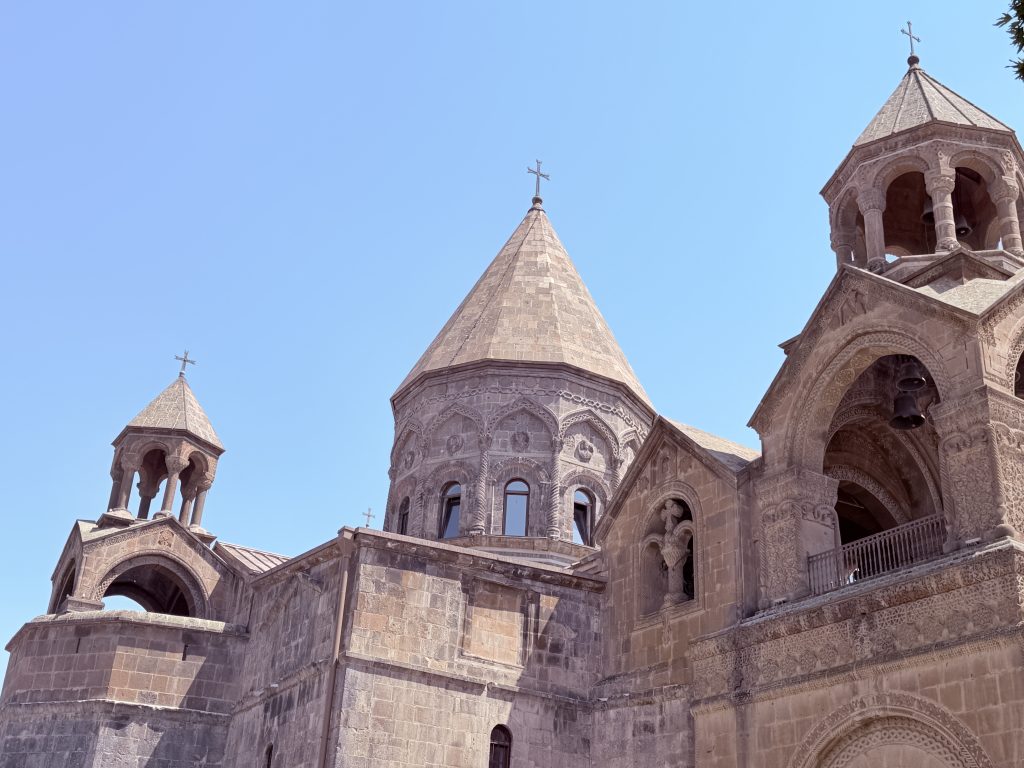
Two places, then, forty miles apart on the same plain, named for two descents: one a man going down into the pit against his will, one God coming down on purpose to meet the ground. I stood in both. The pit is bare rock and that modern ladder, close and silent. The cathedral is the opposite, a mountain of worked stone rebuilt across seventeen centuries, and you can read the centuries in it if you look, the dark weathered courses at the base, the pale carved drum above, the belfry a different stone again, each generation adding its own layer of devotion to the same rectangle of holy ground.
From a story to the evidence beneath it
It is a magnificent story, and a thoughtful person, having stood in both places, eventually asks the honest question: is there reason to credit it beyond the fact that a nation has told it faithfully for a very long time? The stones themselves are modest witnesses. The pit alone proves little; a hole at a fortress capital needs no saint to explain it. The cathedral proves how deeply Armenia believed, which was never the thing in doubt. If the case rested on the architecture, it would rest on devotion alone.
It does not rest there. Turn away from the buildings, toward the things nobody drives out to photograph, property records and priesthoods and a list of names written down by strangers with no reason to flatter Armenia, and the ground gets much firmer than the tradition alone could ever make it.
And here the skeptic has a fair objection ready, the strongest thing he owns. Armenia was not really first, he says. There were Christians there generations before your Gregory. He is right. A bishop named Meruzanes was leading a church in Armenia in the AD 250s; we know because Dionysius of Alexandria wrote to him and Eusebius preserved the fact. The oldest layer of Armenian religious vocabulary is borrowed from Syriac, the fingerprint of a faith that came up quietly from the south long before any king took notice.
Grant every word of it. Individual Armenians had believed for two or three generations, and at the level of the kingdom nothing changed. So the thing that needs explaining is not the first Armenian Christian. It is the moment the state itself, its land, its treasury, its hereditary priesthood, and its king, turned over and reorganized around a crucified God. Belief had cost the crown nothing for decades. Then, in a single reign, it cost the crown everything. That reversal is the event. That is what “the first Christian nation” actually names, and it is the thing the natural explanations have to account for.
Four things that happened, whatever happened in the pit
None of these is a proof by itself. Their force is cumulative: four facts that each admit a small explanation, and together admit only a large one.
A king gave away land, not a building.
When Armenia turned Christian, the estates of the old pagan temples, their fields and villages and revenues, were transferred to the church, and specifically to the family of Gregory, as a permanent and hereditary holding. This is not devotional legend; it is the flat consensus of the serious historians, Nina Garsoïan, Robert Thomson, Robert Hewsen, and it stands independent of any miracle. A king can profess a new god for the price of a decree, and professing costs nothing. But signing away a permanent slice of the realm’s revenue, forever, to one family, and making that family’s priesthood hereditary, is not the move of a man running a calculation. It is the move of a man paying a debt he believes he owes.
A priesthood vanished, and another took its exact place.
Before the conversion, the high priesthood of the old cult belonged to a hereditary house, the Vahevuni, keepers of the temple of Vahagn at Ashtishat. After the conversion, they lose the office, and Gregory’s line stands in precisely the slot they vacated, on the land they had held. This is attested outside the conversion legend, in Movses Khorenatsi and in the Epic Histories, sources that name the old priestly family the legend does not even mention. Their name survives in the later noble registers, so this was the loss of an office, not the killing of a clan. But the office is gone, transferred whole. This is the empty tomb of the Armenian story: not a proof, but an absence that demands an account. Something emptied one priesthood and filled another, permanently, and the only question worth asking is what.
The son sits at Nicaea.
In the year AD 325, at the first great council of the whole Christian church, the attendance lists record a bishop of Greater Armenia. These lists survive in Greek and in a Syriac copy older than nearly anything in the Armenian tradition, edited by no Armenian hand, and the name they carry is Aristakes. The lists confirm a national bishop of Greater Armenia at Nicaea; that this Aristakes was Gregory’s son is what the Armenian tradition adds, and the argument does not lean on the addition. The strong fact is what the strangers wrote down without being asked. Every other bishop on the list is “so-and-so of such-and-such a city.” Aristakes alone has no city. He is simply “of Greater Armenia.” That is not the signature of a town bishop. It is the signature of a national primate, one head over a whole church, and it is there in Greek by AD 325. A faith drifting up quietly from the south does not produce that. Something had already gathered the Armenian church into a single institution with a single man at its head, and outsiders confirm the very shape the story exists to explain.
The text edits itself, and shows us its own hand.
The oldest account of the conversion survives in several versions, and they do not agree, and the disagreement is a gift. In the Greek version, King Trdat makes a speech to the Roman emperor Diocletian: I loathe the so-called Christians; I gave a certain Cappadocian named Gregory to the bitterest death, throwing him into a pit; I will carry out your orders. In the Armenian version, the one that became canonical, that speech is simply gone. Cut. So we hold proof, not suspicion, that the tradition edited its own founding in its own favor. And yet the same editor who cut the king’s collaboration with the persecutor left standing every fact that shames him: that Gregory’s father murdered the king, that Gregory himself was a foreigner raised abroad, that the Armenian church had to go to the Greeks at Caesarea to be consecrated for most of a century. An editor who demonstrably removes what embarrasses him, and who nevertheless leaves the regicide and the foreignness and the dependence in place, is a man fenced in by what his audience already knew to be true. The proof that he edited is exactly what lets us locate what he could not edit. This is the oldest tool in the historian’s kit, the one that trusts a confession precisely for the details no guilty man would invent, and it works here for the same reason it works on the empty tomb: the awkward facts survive because they were too well known to remove.
The story makes less sense any other way
Everyone agrees on the facts underneath. No serious historian doubts that Trdat converted, that the church was endowed, that the priesthood changed hands, that a bishop of Armenia sat at Nicaea. The whole question is what explains the shape of it. It is the same test the empty tomb gets: the natural explanations, taken at their strongest, either carry the weight or they do not.
The first is political calculation. The king turned Christian to buy something, an identity, an alliance, a wall against Persia. It is the best secular reading, and it fails at every date you try to pin it to. Early, around AD 301, Christianity was contraband, and Rome was months from launching the most savage persecution of the church in its history; aligning with Christ then bought you Rome’s enemy, not Rome’s favor. Later, after Rome itself had turned, Armenia was already a Roman client and needed no such wall, and by then conversion cost the king his own pagan nobility and his own priesthood in exchange for a protection he already had. Choose either date. Neither explains why a shrewd king would hand a permanent, hereditary share of his kingdom’s wealth to the family of a man he had jailed.
The second is gradual drift, the idea that all of this was a slow, unremarkable spread of belief dressed up afterward as a single dramatic conversion. But drift produces no national primate at Nicaea in AD 325. Drift does not write specific terms into a land grant. Drift does not leave a founding legend studded with facts that embarrass the men who told it. And drift does not raise, at the old capital near the pit, the kind of large cruciform building archaeologists have lately uncovered there, dated before the middle of the fourth century, a serious and costly structure that a thin trickle of peasant faith does not fund. Set the drift theory beside the actual residue, and it does not so much lose the argument as decline to explain the thing that needs explaining.
This is a claim about probability, not a proof, and history knows no other kind. History is done by asking which account leaves the evidence least surprising, and here the natural accounts leave the central facts strange while the plain account leaves them plain: that something happened between a king and a prisoner, real enough and undeniable enough that a kingdom rebuilt its wealth, its priesthood, and its identity around it and never rebuilt them back.
The one explanation nobody is allowed to weigh
There is a reading of all this that the field will not enter, and it is worth naming why. The geneticist Richard Lewontin once explained, with rare candor, why he and his colleagues hold to material explanations even where the evidence strains against them: not because it compels them, but because “we cannot allow a Divine Foot in the door.” The door is shut before the weighing begins.
I am not making the argument you may think I am. I am not saying the events are unexplained, therefore a miracle. I am saying something narrower and harder to answer: the plain reading, the one that takes the king at his word that he met a power he could not deny, is scored at zero before the counting starts. Not weighed and found wanting. Ruled out in advance, as policy. And a policy is not a conclusion. When every natural candidate has failed on its own terms, at its own preferred dates, the refusal even to consider the remaining explanation is not scholarship. It is the foot braced against the door.
The pit and the hammer are the same tool
I came up out of the pit the easy way, on the bolted ladder, in a few seconds, the way Joseph never came up out of his and the way Gregory, if the story is true, waited thirteen years to. And I keep returning to the two descents that hold this whole thing together.
Khor Virap: the deep pit, a man dragged down into the dark against his will. Etchmiadzin: the descent of the Only-Begotten, God come down on purpose into the same dirt, forty miles and a few years away, to strike the ground with a hammer and say, build here. One man falls; one God descends to meet him at the bottom of the fall. The furnace and the hammer are the instruments the tradition reaches for, and they are the right ones, because they are the tools that break a thing in order to forge it. The pit did not bury Gregory. It made him. The hammer did not shatter the ground. It marked it.
The stones are quiet. The record is not. What a nation pressed permanently into its land and its law and its priesthood was the shape of a debt, the shape a man leaves behind when he becomes convinced he owes everything to a power he cannot dismiss, and pays, and keeps paying, for seventeen hundred years. You cannot photograph that. But you can read it, if you are willing to look where the light does not reach.
Discover more from Cold and Lonely Truth
Subscribe to get the latest posts sent to your email.



Well done, thank you..
Thank you, Mike! I appreciate it. I was fascinated by the minor parallels with Joseph in Egypt.