In Part 1, we examined the manuscript evidence and early church testimony establishing John’s Gospel as an authentic first-century document. But skeptics have long argued that even if John was written early, it still represents theological fiction rather than historical reporting. They pointed to specific geographical and architectural details as “proof” that John invented stories disconnected from real places. Then archaeologists started digging. What they found has fundamentally transformed scholarly assessment of John’s historical reliability. The archaeological evidence supporting the Gospel of John has become increasingly robust.
The Archaeological Revolution: From Skepticism to Vindication
The archaeological revolution of the past century has systematically vindicated John’s topographical precision. Urban C. von Wahlde’s comprehensive study examining 20 geographical locations mentioned in John with specific details not found elsewhere in the New Testament yields remarkable results: 16 sites confirmed accurate, 2 sites likely correct but not fully confirmed, and only 2 sites that cannot be identified with certainty.IVon Wahlde, Urban C. “Archaeology and John’s Gospel.” In Jesus and Archaeology, edited by James H. Charlesworth, 523-586. Grand Rapids: Eerdmans, 2006. Von Wahlde concludes: “No credible evidence to suggest that any of the twenty sites is simply fictitious or symbolic” and “The intrinsic historicity and accuracy of the references should be beyond doubt.”IIVon Wahlde, “Archaeology and John’s Gospel,” 583. This pattern—details dismissed as “obviously fictional” being confirmed by independent archaeological discovery—has repeated throughout the past 150 years. Let’s examine the most dramatic cases.
The Pool of Bethesda: Archaeological and Linguistic Vindication
For centuries, John 5:2’s description of a pool “having five porticoes” was dismissed by skeptical scholars as symbolic fiction—some even claimed it represented the five books of Torah because the architectural configuration seemed implausible. This was considered proof of John’s unreliability. Then excavations beginning in the 1880s revealed the structure exactly as John described it: two large rectangular pools separated by a rock dam, with four porticoes surrounding the outer perimeter and a fifth portico running along the central dividing wall. The dimensions matched (each side approximately 131 yards long and 55 yards wide, depth of 13 meters). The site was confirmed to be in use during the Second Temple period until AD 70. 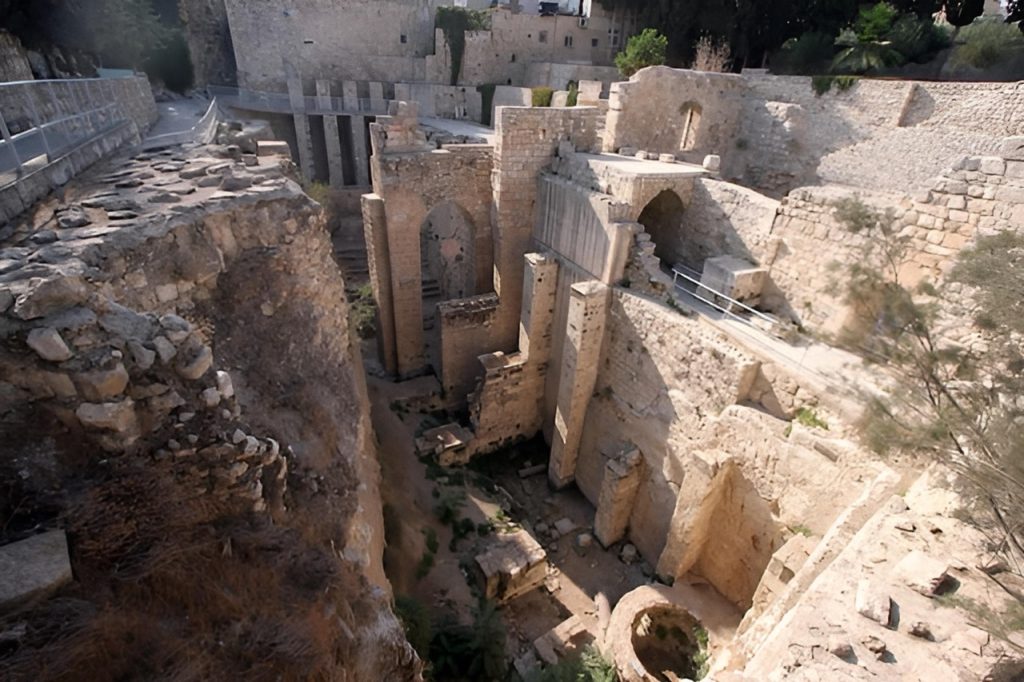 Additionally, the Copper Scroll from Qumran (dated 25-68 AD) independently references “Beth Eshdathayin” (House of the Two Pools), corroborating the twin-pool design.IIIVon Wahlde, “Archaeology and John’s Gospel,” 563-566. Detailed architectural description. See also: Von Wahlde, Urban C. “The Puzzling Pool of Bethesda.” Biblical Archaeology Review 37.5 (2011): 40-65.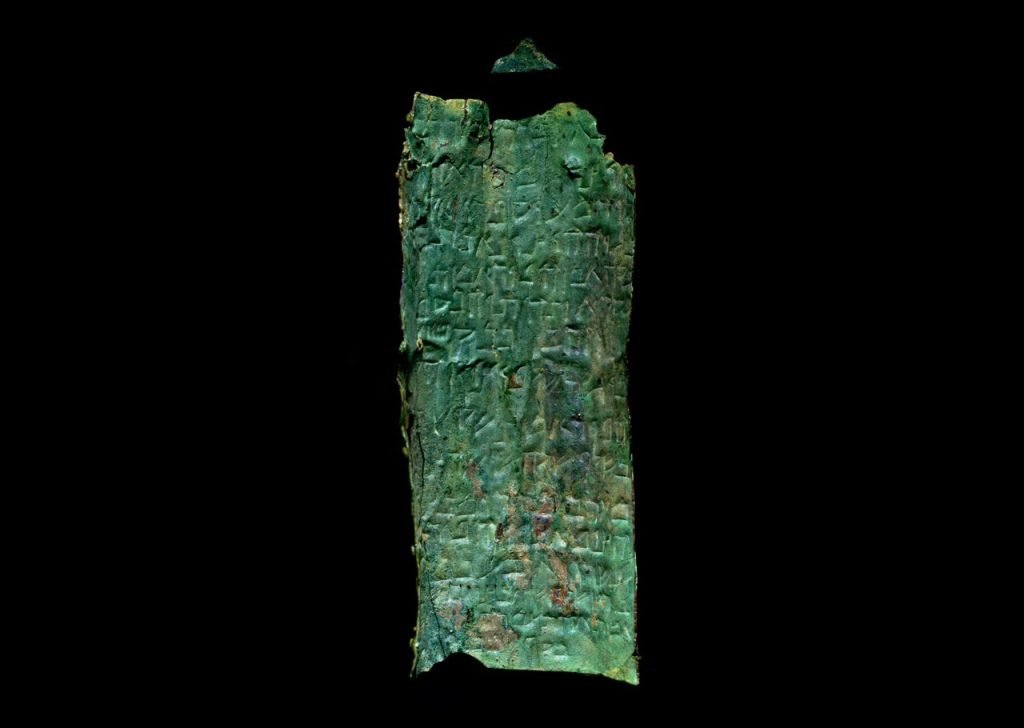
The Grammar Proves Early Dating
But there’s more—the grammar proves early dating. John 5:2 states: “Now there IS (ἐστιν) in Jerusalem by the Sheep Gate a pool, which is called in Hebrew, Bethesda, having five porches.” John uses three present tenses: ἐστιν (“there is”), ἐπιλεγομένη (“is called”), and ἔχουσα (“having”)—sharply contrasting with past tenses in surrounding verses (5:1, 5:3). George van Kooten’s 2024 research shows the formula “there is (ἐστιν δὲ ἐν) + locality + architectural structure” has been used consistently since Herodotus to describe existing structures, not destroyed ones. Since Josephus records both the gate and pool were destroyed by Romans in AD 70, the author’s present-tense description most naturally indicates pre-destruction composition around AD 65.IVVan Kooten, George. “Dating the Gospel of John on the Basis of Its Linguistic Evidence: John 5:2 and the Date of the Gospel.” Novum Testamentum 66 (2024): 1-25. Scholars continue to date John to 90-100 AD based on assumptions about “theological development.” They used the “obviously fictional” five porticoes as proof—until archaeology proved them precisely wrong. Van Kooten’s work has prompted scholars like N.T. Wright, Peter J. Williams, and Richard Bauckham to reconsider late-dating assumptions. Von Wahlde identifies the Pool of Bethesda as among the two largest mikva’ot (Jewish ritual purity baths) in Jerusalem. He observes: “That both of these pools are mentioned only in the Gospel of John in the New Testament reflects John’s intimate knowledge of Jerusalem…It is precisely those places described in the greatest detail that can be identified with the greatest certitude.”VVon Wahlde, “Archaeology and John’s Gospel,” 566.
Addressing the “Six Porticoes” Objection
Some skeptics claim archaeological evidence reveals six or seven porticoes rather than John’s stated five, allegedly demonstrating historical inaccuracy. This objection misunderstands both ancient architectural terminology and the site’s actual configuration. The Pool of Bethesda consists of two rectangular pools separated by a central partition. The five porticoes are four colonnades surrounding the outer perimeter plus one spanning the central dividing wall between the pools—exactly as John describes. The confusion arises from several sources: double-counting corner columns as separate porticoes, conflating individual columns with complete porticoes (covered walkways), or including later Byzantine-era additions from the 4th-5th centuries that post-date John’s account by centuries. Urban von Wahlde’s comprehensive archaeological analysis confirms the five-portico configuration matches the Second Temple period structure precisely. The independent testimony of the Copper Scroll corroborates the twin-pool design John knew.VIVon Wahlde, “Archaeology and John’s Gospel,” 564-565.
The Pool of Siloam: From Byzantine Confusion to Second Temple Clarity
For centuries, a Byzantine-era pool from the fifth century was considered the Pool of Siloam. During routine sewage pipe repair in June 2004, excavators Ronny Reich and Eli Shukron discovered a large monumental pool from the Second Temple period—225 feet long by approximately 150 feet wide, with broad stone steps and landings descending into the trapezoidal-shaped pool.  Coins found at the site from the late Hasmonean period (circa 90 BC) and Jewish Revolt (AD 66-70), along with first-century pottery, confirm the pool was in use until Jerusalem’s destruction in AD 70 and rapidly silted over afterward.VIIReich, Ronny and Eli Shukron. “Light at the End of the Tunnel.” Biblical Archaeology Review 25.1 (1999): 22-33, 72; Reich, Ronny. “The Pool of Siloam.” In New Studies in the Archaeology of Jerusalem and Its Region, edited by D. Amit et al., 143-151. Jerusalem: Israel Antiquities Authority, 2008. James Charlesworth of Princeton announced the discovery’s significance: “A gospel that was thought to be ‘pure theology’ is now shown to be grounded in history.”VIIICharlesworth, James H. Quoted in Associated Press report, August 9, 2005. Also referenced in Charlesworth, James H., ed. Jesus and Archaeology. Grand Rapids: Eerdmans, 2006, introduction. The pool was fed by Hezekiah’s Tunnel from the Gihon Spring, part of the water system built in the late eighth century BC, recorded in 2 Kings 20:20. The Siloam Inscription, discovered in 1880, describes the tunnel’s construction in ancient Hebrew. The pool’s identification as a mikveh for ritual purification before Temple entry explains why Jesus sent the blind man there for healing—it was on the pilgrimage route between the City of David and the Temple Mount. Recent excavations have revealed a 700-yard stepped Pilgrimage Road connecting the Pool of Siloam directly to the Temple Mount, with coins from the First Revolt confirming its first-century use.IXVon Wahlde, Urban C. “The Pool of Siloam: The Importance of the New Discoveries for Our Understanding of Ritual Immersion in Late Second Temple Judaism and the Gospel of John.” In John, Jesus, and History, Volume 2: Aspects of Historicity in the Fourth Gospel, edited by Paul N. Anderson, Felix Just, and Tom Thatcher, 155-174. Atlanta: SBL Press, 2009.
Bethany Beyond Jordan: UNESCO World Heritage Confirmation
Excavations from 1996-2002 at Al-Maghtas led by Mohammad Waheeb discovered over 20 Christian sites dated to the third-to-seventh centuries, including a third-century church possibly marking Jesus’s baptism site and a sixth-century cave chapel with Greek inscriptions referencing John the Baptist. The site was designated a UNESCO World Heritage Site in 2015. Joan E. Taylor’s detailed study in the ARAM journal supports the identification. While Jodi Magness cautions that Byzantine veneration from the fourth century onward, while confirmed, doesn’t definitively establish continuous tradition from the first century, the archaeological evidence demonstrates Christians in the third century identified this specific location with John’s Gospel narrative.XTaylor, Joan E. “John the Baptist on the Jordan River: Localities and Significance.” ARAM 29.1/2 (2017): 1-19; Magness, Jodi. “Where Christianity Was Born: Bethany Beyond the Jordan.” Biblical Archaeology Review 39.1 (2013): 32-43, 56-59.
Historical Figures: Independent Corroboration
The archaeological evidence for historical figures mentioned in John provides independent corroboration from non-Christian sources.
The Pilate Stone
The Pilate Stone discovered at Caesarea Maritima in 1961 contains a limestone inscription reading “Tiberieum / (Pon)tius / (Praef)ectus Iuda(eae),” confirming Pontius Pilate’s existence and exact title as “Prefect of Judea” under Tiberius during 26-36 AD, matching the Gospel timeline. Bronze coins struck by Pilate 29-32 AD provide additional evidence.XIFor the Pilate Stone see: Frova, Antonio. “L’iscrizione di Ponzio Pilato a Cesarea.” Rendiconti dell’Istituto Lombardo, Classe di Lettere 95 (1961): 419-434. Discussion in Blomberg, Historical Reliability of John’s Gospel, 40.
The Caiaphas Ossuary
The Caiaphas Ossuary discovered in 1990 in Jerusalem’s Peace Forest contains the Aramaic inscription “Joseph son of Caiaphas,” confirming the high priest’s existence with first-century dating. This validates John’s detailed knowledge of the high priestly family, including the proper identification of Annas as Caiaphas’s father-in-law (John 18:13).XIIGreenhut, Zvi. “Burial Cave of the Caiaphas Family.” Biblical Archaeology Review 18.5 (1992): 28-36, 76; Reich, Ronny. “Caiaphas Name Inscribed on Bone Boxes.” Biblical Archaeology Review 18.5 (1992): 38-44, 76.
Crucifixion Evidence
Skeletal remains of a crucified man named Jehohanan discovered in 1968 confirm the use of nails through the heel bone and leg bone fracture (crurifragium), validating John’s unique references to nails (20:25) and leg-breaking (19:32) in Jerusalem crucifixions. This archaeological evidence proves John’s detailed knowledge of Roman crucifixion practices matched actual first-century methods.XIIITzaferis, Vassilios. “Jewish Tombs at and near Giv’at ha-Mivtar, Jerusalem.” Israel Exploration Journal 20 (1970): 18-32; Haas, Nicu. “Anthropological Observations on the Skeletal Remains from Giv’at ha-Mivtar.” Israel Exploration Journal 20 (1970): 38-59.
Comprehensive Archaeological Confirmation
Andreas Köstenberger identifies 14 major archaeological findings corroborating John:
- The inscription barring Gentiles from the Temple
- Herod’s Temple structures
- Jacob’s well
- Pool of Bethesda
- An ancient fishing boat
- Early synagogue remains
- Pool of Siloam
- Siloam inscription
- Tomb of Lazarus traditions
- Caiaphas tomb and inscription
- Pilate inscription
- Stone pavement (Lithostrotos/Gabbatha)
- Skeletal remains of the crucified man
- Garden tomb traditions near GolgothaXIVKöstenberger, Andreas J. Encountering John: The Gospel in Historical, Literary, and Theological Perspective. 2nd ed. Grand Rapids: Baker Academic, 2013, 75-82.
This archaeological corroboration led Paul N. Anderson to observe that John contains “more empirical (sensorily attributed) references, topographical details, and archaeologically attested features than all the other gospels combined—canonical and otherwise. This is an empirical fact.”XVAnderson, “Aspects of Historicity,” 595. Anderson’s exact phrase.
External Non-Christian Sources Corroborate Historical Context
Independent non-Christian sources provide substantial corroboration for historical figures and contexts in John’s Gospel.
Flavius Josephus
Josephus, the first-century Jewish historian writing Antiquities of the Jews around 93-94 AD, provides the most significant external validation. In Antiquities 18:116-119, Josephus describes John the Baptist’s ministry, stating he preached baptism of repentance for remission of sins, attracted many followers, spoke against Herod’s adulterous relationship, was imprisoned by Herod to prevent potential uprising, and was executed. This largely matches Gospel accounts from an independent Jewish perspective.XVIJosephus, Antiquities of the Jews 18.116-119. For discussion see: Meier, John P. A Marginal Jew: Rethinking the Historical Jesus. Vol. 2. New York: Doubleday, 1994, 19-25, 56-62. In Antiquities 20:200, Josephus mentions “James, the brother of Jesus who was called Christ,” providing independent confirmation of Jesus as a historical figure from a non-Christian Jewish source.XVIIJosephus, Antiquities of the Jews 20.200. Discussion in Meier, Marginal Jew, 2:57-59. The Testimonium Flavianum (Antiquities 18:63-64), while containing probable Christian interpolations, is considered by most scholars to have an authentic core. The probable original content stated Jesus was “a wise man,” performed “surprising deeds” (paradoxa erga), attracted Jewish and Greek followers, was crucified under Pontius Pilate, and his disciples continued the movement after his death.XVIIIJosephus, Antiquities of the Jews 18.63-64. For scholarly reconstruction of the original text see: Meier, Marginal Jew, 1:56-69; Whealey, Alice. “The Testimonium Flavianum in Syriac and Arabic.” New Testament Studies 54 (2008): 573-590.
Tacitus
The Roman historian Tacitus provides hostile independent confirmation in Annals 15:44 (written circa 115 AD): “Christus, from whom the name had its origin, suffered the extreme penalty during the reign of Tiberius at the hands of one of our procurators, Pontius Pilate.”XIXTacitus, Annals 15.44. Latin text and translation in: Tacitus. The Annals. Translated by A.J. Woodman. Indianapolis: Hackett, 2004. As a hostile Roman source with no reason to aid Christianity, Tacitus provides powerful corroboration for the crucifixion under Pilate. John Dominic Crossan, a skeptical historical Jesus scholar, acknowledges: “That he was crucified is as sure as anything historical can ever be, since both Josephus and Tacitus…agree with the Christian accounts on at least that basic fact.”XXCrossan, John Dominic. Jesus: A Revolutionary Biography. San Francisco: HarperSanFrancisco, 1994, 145.
Philo of Alexandria
Philo’s Legatio ad Caium 38 describes Pilate’s character and actions, confirming his provocative behavior toward Jews and religious insensitivity, which aligns with John’s portrayal of Pilate as politically vulnerable and susceptible to crowd pressure (19:12). The convergence of Josephus, Tacitus, and Philo provides independent confirmation of the historical and political context John describes.XXIPhilo, Legatio ad Caium 38. For discussion of Philo’s portrayal see: Bond, Helen K. Pontius Pilate in History and Interpretation. Cambridge: Cambridge University Press, 1998, 30-47.
The Pattern of Evidence
The archaeological and historical evidence reveals a consistent pattern: where John can be checked against external evidence, John proves accurate. Details critics dismissed as “theological invention” have been systematically confirmed by independent discovery. The principle illustrated by the Pool of Bethesda applies broadly: specific details mentioned in greatest detail can be identified with greatest certainty. This is precisely backward from what we’d expect if John were inventing stories. A forger would avoid specific, verifiable details that could expose the fiction. An eyewitness naturally includes precise geographical, architectural, and chronological details because that’s how authentic memory works. Von Wahlde’s analysis shows 16 of 20 locations confirmed accurate with zero proven inaccurate. The two unidentifiable sites simply lack sufficient archaeological evidence yet—absence of evidence is not evidence of absence. The pattern warrants confidence regarding claims that cannot currently be verified.
Jewish Practices and Festival Knowledge
Beyond physical geography, John demonstrates exceptional knowledge of Jewish festivals, Temple practices, and Palestinian customs that characterize authentic first-century testimony. John structures his narrative around Jewish festivals more systematically than the Synoptic Gospels, mentioning seven feasts: three Passovers (2:13, 23; 6:4; 11:55), an unnamed feast possibly Pentecost or Purim (5:1), the Feast of Tabernacles (7:2-14), and the Feast of Dedication/Hanukkah (10:22, noting “it was winter”). This festival framework provides a thoroughly chronological structure for a three-year ministry, which most scholars now consider more historically plausible than the Synoptic Gospels’ apparent one-year framework.XXIIKeener, Gospel of John, 1:394-407. Discussion of Jewish festivals in John’s structure. The Gospel demonstrates intimate knowledge of festival symbolism and Temple rituals. During Tabernacles, John records Jesus proclaiming on “the last and greatest day of the feast” (7:37) about “living water,” alluding to the water libation ceremony performed throughout the feast. Jesus’s declaration “I am the light of the world” (8:12) occurs during the same festival when massive menorahs were lit in the Temple courts, illuminating Jerusalem.XXIIIKeener, Gospel of John, 2:712-728 (Tabernacles), 730-739 (light symbolism). Craig Keener’s massive two-volume, 1,600-page commentary provides over 20,000 ancient extra-biblical references demonstrating John’s accuracy regarding Jewish festival symbolism, Temple architecture, Greco-Roman cultural conventions, and Palestinian geography. Keener concludes John is “a treasure trove of information about the origins of Christianity” that demonstrates “the Jewishness and the essential reliability of the traditions about Jesus preserved in John’s Gospel.”XXIVKeener, Gospel of John, 1:xlvii (from the introduction).
Scholarly Consensus Shifts Toward Greater Historical Respect
The 20th-century skepticism regarding John’s historical value has given way to 21st-century recognition that while theologically interpreted, John preserves genuine historical tradition with superior knowledge of time and place. The discovery of P52 demolished 19th-century late-dating theories. The Dead Sea Scrolls proved John’s linguistic style was Palestinian Jewish, not late Gnostic. W.F. Albright’s archaeological work demonstrated topographical details required pre-AD 70 knowledge.XXVAlbright, William F. “Recent Discoveries in Palestine and the Gospel of St. John.” In The Background of the New Testament and Its Eschatology, edited by W.D. Davies and D. Daube, 153-171. Cambridge: Cambridge University Press, 1956. Raymond Brown, though critical, recognized in the 1960s that archaeological evidence demanded reassessment and acknowledged that John contains historical tradition alongside theology.XXVIBrown, Raymond E. “The Problem of Historicity in John.” Catholic Biblical Quarterly 24 (1962): 1-14. Paul N. Anderson’s “John: The Mundane Gospel” thesis documents that John contains more empirical references, topographical details, and archaeologically attested features than all Synoptic Gospels combined. Anderson calls for a “Fourth Quest” for the historical Jesus that includes John, editing the nine-volume John, Jesus, and History project.XXVIIAnderson, Paul N., Felix Just, and Tom Thatcher, eds. John, Jesus, and History series. 4 volumes published 2007-2024. Atlanta: SBL Press. James Charlesworth organized international conferences on John’s historicity and asks whether archaeology requires a “paradigm shift” in evaluating John.XXVIIICharlesworth, Jesus and Archaeology. See editor’s introduction. Craig Blomberg’s The Historical Reliability of John’s Gospel (2001) documents extensive archaeological corroboration.XXIXBlomberg, Historical Reliability of John’s Gospel. Richard Bauckham’s Jesus and the Eyewitnesses (2006) argues for eyewitness tradition underlying all four Gospels including John.XXXBauckham, Jesus and the Eyewitnesses. Current scholarly consensus acknowledges significant areas of agreement: John contains authentic topographical tradition from first-century Palestine, the author or tradition possessed intimate knowledge of Jerusalem before AD 70, archaeological discoveries vindicate previously doubted details, John cannot be dismissed as purely theological fiction, and some historical core underlies the narrative.
What the Archaeological Evidence for the Gospel of John Means
The archaeological evidence establishes that John’s Gospel:
- Contains precise topographical knowledge of pre-70 AD Jerusalem that would be lost after the Temple’s destruction
- Accurately describes architectural details once dismissed as symbolic fiction
- Demonstrates intimate knowledge of Jewish practices and festivals characteristic of first-century Palestinian Judaism
- References historical figures confirmed by independent non-Christian sources
- Preserves geographical and cultural details that characterize eyewitness testimony rather than distant fabrication
The pattern is undeniable: where John can be checked, John proves accurate. This pattern warrants confidence regarding claims that cannot currently be verified archaeologically. Next in this series: Part 3 will examine the dating evidence, address critical scholarly challenges, and explore why skepticism persists despite mounting evidence.
This is Part 2 of a 3-part series on the historical reliability of John’s Gospel. [Read Part 1: Gospel of John and the Manuscript Evidence →] [Read Part 3: Dating the Gospel of John and Scholarly Responses →]
References
| ↵I | Von Wahlde, Urban C. “Archaeology and John’s Gospel.” In Jesus and Archaeology, edited by James H. Charlesworth, 523-586. Grand Rapids: Eerdmans, 2006. |
|---|---|
| ↵II | Von Wahlde, “Archaeology and John’s Gospel,” 583. |
| ↵III | Von Wahlde, “Archaeology and John’s Gospel,” 563-566. Detailed architectural description. See also: Von Wahlde, Urban C. “The Puzzling Pool of Bethesda.” Biblical Archaeology Review 37.5 (2011): 40-65. |
| ↵IV | Van Kooten, George. “Dating the Gospel of John on the Basis of Its Linguistic Evidence: John 5:2 and the Date of the Gospel.” Novum Testamentum 66 (2024): 1-25. |
| ↵V | Von Wahlde, “Archaeology and John’s Gospel,” 566. |
| ↵VI | Von Wahlde, “Archaeology and John’s Gospel,” 564-565. |
| ↵VII | Reich, Ronny and Eli Shukron. “Light at the End of the Tunnel.” Biblical Archaeology Review 25.1 (1999): 22-33, 72; Reich, Ronny. “The Pool of Siloam.” In New Studies in the Archaeology of Jerusalem and Its Region, edited by D. Amit et al., 143-151. Jerusalem: Israel Antiquities Authority, 2008. |
| ↵VIII | Charlesworth, James H. Quoted in Associated Press report, August 9, 2005. Also referenced in Charlesworth, James H., ed. Jesus and Archaeology. Grand Rapids: Eerdmans, 2006, introduction. |
| ↵IX | Von Wahlde, Urban C. “The Pool of Siloam: The Importance of the New Discoveries for Our Understanding of Ritual Immersion in Late Second Temple Judaism and the Gospel of John.” In John, Jesus, and History, Volume 2: Aspects of Historicity in the Fourth Gospel, edited by Paul N. Anderson, Felix Just, and Tom Thatcher, 155-174. Atlanta: SBL Press, 2009. |
| ↵X | Taylor, Joan E. “John the Baptist on the Jordan River: Localities and Significance.” ARAM 29.1/2 (2017): 1-19; Magness, Jodi. “Where Christianity Was Born: Bethany Beyond the Jordan.” Biblical Archaeology Review 39.1 (2013): 32-43, 56-59. |
| ↵XI | For the Pilate Stone see: Frova, Antonio. “L’iscrizione di Ponzio Pilato a Cesarea.” Rendiconti dell’Istituto Lombardo, Classe di Lettere 95 (1961): 419-434. Discussion in Blomberg, Historical Reliability of John’s Gospel, 40. |
| ↵XII | Greenhut, Zvi. “Burial Cave of the Caiaphas Family.” Biblical Archaeology Review 18.5 (1992): 28-36, 76; Reich, Ronny. “Caiaphas Name Inscribed on Bone Boxes.” Biblical Archaeology Review 18.5 (1992): 38-44, 76. |
| ↵XIII | Tzaferis, Vassilios. “Jewish Tombs at and near Giv’at ha-Mivtar, Jerusalem.” Israel Exploration Journal 20 (1970): 18-32; Haas, Nicu. “Anthropological Observations on the Skeletal Remains from Giv’at ha-Mivtar.” Israel Exploration Journal 20 (1970): 38-59. |
| ↵XIV | Köstenberger, Andreas J. Encountering John: The Gospel in Historical, Literary, and Theological Perspective. 2nd ed. Grand Rapids: Baker Academic, 2013, 75-82. |
| ↵XV | Anderson, “Aspects of Historicity,” 595. Anderson’s exact phrase. |
| ↵XVI | Josephus, Antiquities of the Jews 18.116-119. For discussion see: Meier, John P. A Marginal Jew: Rethinking the Historical Jesus. Vol. 2. New York: Doubleday, 1994, 19-25, 56-62. |
| ↵XVII | Josephus, Antiquities of the Jews 20.200. Discussion in Meier, Marginal Jew, 2:57-59. |
| ↵XVIII | Josephus, Antiquities of the Jews 18.63-64. For scholarly reconstruction of the original text see: Meier, Marginal Jew, 1:56-69; Whealey, Alice. “The Testimonium Flavianum in Syriac and Arabic.” New Testament Studies 54 (2008): 573-590. |
| ↵XIX | Tacitus, Annals 15.44. Latin text and translation in: Tacitus. The Annals. Translated by A.J. Woodman. Indianapolis: Hackett, 2004. |
| ↵XX | Crossan, John Dominic. Jesus: A Revolutionary Biography. San Francisco: HarperSanFrancisco, 1994, 145. |
| ↵XXI | Philo, Legatio ad Caium 38. For discussion of Philo’s portrayal see: Bond, Helen K. Pontius Pilate in History and Interpretation. Cambridge: Cambridge University Press, 1998, 30-47. |
| ↵XXII | Keener, Gospel of John, 1:394-407. Discussion of Jewish festivals in John’s structure. |
| ↵XXIII | Keener, Gospel of John, 2:712-728 (Tabernacles), 730-739 (light symbolism). |
| ↵XXIV | Keener, Gospel of John, 1:xlvii (from the introduction). |
| ↵XXV | Albright, William F. “Recent Discoveries in Palestine and the Gospel of St. John.” In The Background of the New Testament and Its Eschatology, edited by W.D. Davies and D. Daube, 153-171. Cambridge: Cambridge University Press, 1956. |
| ↵XXVI | Brown, Raymond E. “The Problem of Historicity in John.” Catholic Biblical Quarterly 24 (1962): 1-14. |
| ↵XXVII | Anderson, Paul N., Felix Just, and Tom Thatcher, eds. John, Jesus, and History series. 4 volumes published 2007-2024. Atlanta: SBL Press. |
| ↵XXVIII | Charlesworth, Jesus and Archaeology. See editor’s introduction. |
| ↵XXIX | Blomberg, Historical Reliability of John’s Gospel. |
| ↵XXX | Bauckham, Jesus and the Eyewitnesses. |
Discover more from Cold and Lonely Truth
Subscribe to get the latest posts sent to your email.